Friday, June 24, 2016

Musings On Anchoring

Le Marin, Martinique. The largest stand of deciduous aluminum we've seen so far.
Over the years, we've gotten used to being vigilant of having enough water under the keel as we approach a new anchorage. In the Caribbean, we are learning that anchorages can also be too deep.

Symbiosis carries 200' of 3/8" chain to go with our Spade anchor. But we've been encountering anchorages that are 30 to 40 feet at the shallowest accessible points. That means a 7-to-1 scope is not even possible in some cases.

Fifty more feet of chain would make a difference, but when we purchased the rode last year, the extra weight in the bow and the added expense of additional chain didn't seem worth it. Now, we wish we had more.

A few weeks ago, we anchored on the edge of a mooring field in Guadeloupe. When we dropped the hook, we had plenty of room with the prevailing easterlies. A squall came through about two hours later and all was well. But when the wind abated, the boats went all whopperjawed (as my father used to say) and we ended up uncomfortably close to a French catamaran. The owner and I kept eyeing each other. We'd have moved if there had been a place to go, but where? Anything closer to shore was chock-a-block already and anything farther offshore dropped off precipitously. The wind soon shifted and there was no issue, after all.

Before a squall moved in, we witnessed a 50' pilothouse cutter that began dragging with no one aboard. We watched for a while hoping to see the owner dinghy out to rescue his wayward vessel. As the boat drifted farther and farther out, I got a knot in my stomach and called a "securite" on the VHF hoping the owner, who was obviously ashore, might have a handheld with him/her. Nothing. I called several times. I thought about trying to get out there and do something -- but that's a dicey proposition. Some people would not react kindly, even if it was obvious we were trying to save their boat. For the record, I'd rather have my boat than my pride, but that's just me.

Now we are in Le Marin, where we have seen the largest concentration of sailboats anywhere, and that includes George Town, Bahamas! We've heard there are 700 charter boats (mostly catamarans) alone, let alone all the privately owned boats. The lagoon is full of shoals and packed with moorings that are all taken up by the locals, leaving room to anchor only on the margins. Based on our initial attempts to lay down our Spade, we were not encouraged. The Spade almost always catches on the first try, but twice we didn't get a good set. Finally, as we were powering back to set the anchor the second time, it caught. Since then (a few days ago), we've had no issues.

(Adding this in circa Aug. 2016. Here's a great video discussing some of the issues associated with deeper-water anchoring)

ActiveCaptain reviewers generally rate the holding here as "excellent" to "good," but I think there's a bit of anchoring inflation going on.

Thursday, June 23, 2016

Dominica And Quelques Iles Françaises

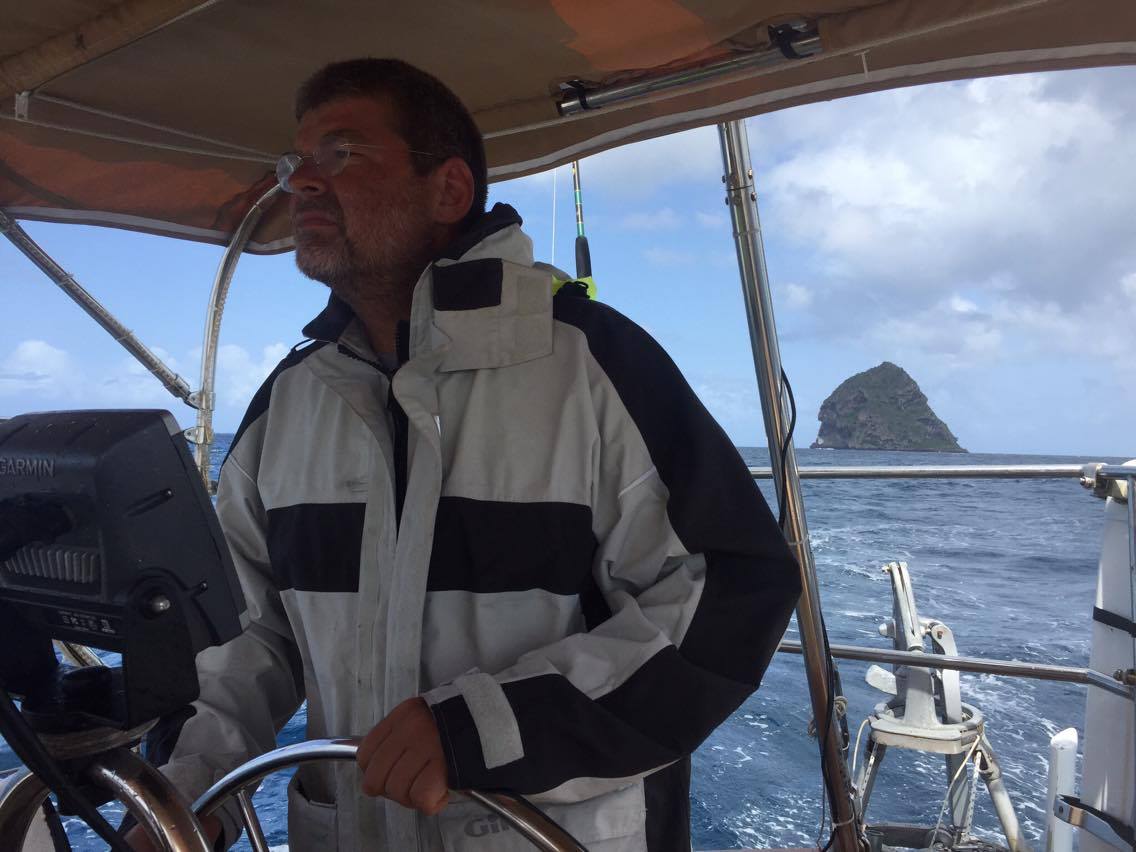
The famed Diamond Rock in the background. Southern Martinique.
We left Frank and Diane at Antigua as they were busy decommissioning Utopia for a summer and autumn on the hard. They are flying back to New York, where they will rest up and spend some time with family. We really enjoyed cruising with those two and will miss them. We did a lot of exploring and crossed some potentially nasty stretches of water together. Hope we can catch up when their season resumes circa December.

Today, we are anchored in Le Marin lagoon in southern Martinique. We've been traveling in company with Larry and Debbie on the trawler Tropical Blend since leaving together (coincidentally) from Antigua en route to Guadeloupe. I say coincidentally, but really there's not much serendipity about such things -- everyone is looking at the same weather and when it looks good (on average about one day out of a week), most people scatter to the winds.

We seem to share some of the same interests and outlook with Debbie and Larry and under normal conditions their Nordhaven 43 and our Tayana 37 seem to make about the same speed whether we are sailing or motoring. So, it's a pretty good match all around.

On the Antigua to Guadeloupe run we were both struggling a bit against short chop. At one point on the passage, Noi turned around and noticed several of our plastic jerry jugs drifting off into our wake. Somehow they'd worked loose from what I thought was a foolproof tie-down system I had engineered before leaving Antigua. The conditions would have made it difficult and/or dangerous to retrieve them, so all we could do was get on the VHF and warn Tropical Blend -- about a mile behind us -- not to run them over. Debbie had already caught sight of them and remarked to Larry about how well marked the fish nets were, as normally they are little more than a couple of plastic water bottles lashed together.

We arrived in Deshaies and checked in. It was probably the simplest clearing of customs and immigration we have ever had. The whole thing was done on computer in a local souvenir shop amid women's swimwear, hand-made bracelets and various bric-a-brac. The proprietor/customs agent didn't even stamp our passports! Deshaies is a cute little town, "little" being the operative word.

We didn't get much exploring done in Guadeloupe, but hope to do so on our way back north in the winter. However at the next island, Dominica, we took a few tours and got to see quite a lot. It's simply spectacular -- lush with flora of every variety. In fact, Noi and I agree that it's our favorite spot thus far. We went up the Indian River, which flows into Portsmouth harbour, which was fascinating. Among other things, some of the scenes from one of the Pirates of the Caribbean movies was shot there. We also took a driving tour with Larry and Debbie around the island, including the Atlantic Coast -- a trip which left us awed in the true sense of the word.

Post-card perfect: the stunning windward coast of Dominica.


When we arrived in Portsmouth, we got our first taste of the "boat boy" culture. As we approached the harbour, we could see a small yellow wooden skiff loitering at the edge of the bay and we were soon approach by Titus on Lawrence of Arabia. Titus offered to show us a mooring and to help with any arrangements for tours, as well as the daily necessities, such as water, ice, fuel, etc. Later that day as we dinghied back from clearing customs and immigration to our mooring (quite some distance), our tiny outboard quit and could not be restarted. I was fully prepared to row back, but when a man named Bonti in a black boat offered to tow us back, that suited me just fine. We offered him the equivalent of USD$5 for his trouble and inadvertently accepted a guided river tour from him. I suspected this was going to be a problem, and it was. Next we saw Titus, we tried to explain the arrangement, but he was having none of it. That's not protocol and Bonti was an usurper, he insisted. It finally got straightened out, but not without some hard feelings on Bonti's part.

Indian River, Dominica.


A few days after arriving in Portsmouth, I was sitting in the cockpit of Symbiosis when the most derelict-looking small sloop came peeling down the bay, expertly sailed between the moored boats by a scruffy 20-something in a straw hat. The 27' boat -- topsides streaked with black marks -- belonged to single-hander Sean. Sean, we later discovered, had sailed west from San Francisco seven years earlier and was now three-quarters of the way around the world. We had him aboard for dinner one night -- a likable enough guy, but at nearly 30 exhibiting the quirks we've started to recognize in the long-term solo sailor. Let's just say that reintegrating with "the real world" (whatever that is!) would be difficult for him. He doesn't seem to be in any hurry to do it, either.

Soursop. A peculiar but delicious fruit. Portsmouth, Dominica.
On the same day, our dinghy worked loose from a perfectly tied clove-hitch and started drifting out of the harbor. Noi spotted it and yelled instinctively "Get it!" Without thinking, I dived in and swam as hard as I could toward it, which for me is not very fast. But with the wind and current heading out, I soon realized it was a lost cause. When I saw a neighboring boat launch its sailing dinghy to recover our hapless dink, I turned back with some relief. Now, however, I was fighting the wind and current on the return. I barely made it back, grabbing a line Noi had thrown for the last few feet.

Jahn returned our dinghy and we decided to repay the favor with an invitation to sundowners. Jahn has been sailing the Caribbean islands for the past dozen years and turned out to have some valuable insights for us. He also has bought a small parcel of land on Dominica and, along with his wife (who returns to Germany for several months a year) expected to settle there eventually. He took Noi, Sean and myself out to see the land and we helped clear out some wild lemongrass for some new plantings.

From Portsmouth, we hopped down the coast with Tropical Blend to Roseau (pronounced ROSE-oh), the capital. En route to Roseau, just 15 miles down the west coast, we managed to rip our mainsail again, this time straight across -- a tear that encompassed the old repair and then some. It was my fault (Scott's). I released a cam cleat that holds a reefing line, but didn't notice that it had somehow reset itself while I was raising the main. When I felt resistance, I should have stopped cranking the winch, but I didn't. We've swapped it for our old backup main and are planning to have the repair down in St. Lucia.

After a few more days, it was off to the French island of Martinique. The best part about that passage from Dominica to Martinique was finally getting our Aries windvane self-steering to work! Sean and Jahn both had experience with windvanes and gave us a few pointers to make the linkage from the vane to the helm work. I (Scott) experimented with it and did some tweaking. After about 20 minutes of fiddling, it worked! It steered the whole way on a close reach. Here's a video of the Aries in action!


Before we departed Portsmouth, Jahn had insisted that St. Pierre in Martinique was a decent anchorage. But reading the reviews on Active Captain was not too encouraging. There is a very narrow shelf suitable for anchoring very close to shore and then a steep drop off into quite deep water. The reports of holding were only "fair" with caveats about dragging anchor. If the anchor dragged and fell off that steep ledge, it would obviously not re-set itself. Worse yet, it would probably be unrecoverable. But the good ship Tropical Blend was keen on going there -- it would make the trip from Roseau more manageable rather than going all the way to Martinique's capital, Fort de France on the southern tip of the island. So, we decided to try it. There was one report of the nearby beach being a better anchorage and while doing some research in other guidebooks, Larry also stumbled on this alternate spot at Anse Turin. It promised a much wider shelf with sand and mud and good holding. It turned out to be an excellent choice. The beach was not too far from the town and the holding was indeed very good. The only problem we had was on Saturday morning when some local fishermen asked Tropical Blend to move so they could run their enormous net out. Apparently Symbiosis was OK and Larry and Debbie just moved their boat over a few hundred feet.

St. Pierre is a charming town. It has gradually recovered since a massive and sudden depopulation in 1902, when a volcano (Mt. Pelee) erupted hot gas, killing all but two of the approximately 30,000 residents -- one of them a prisoner whose cell apparently saved him from death. There was little or no lava flow, however, so the volcano had the effect of a neutron bomb, wiping out the people but not the buildings. Now it is again a going concern. A bit sleepy for sure. "Quaint." The Saturday vegetable market is a great place to stock up.

From St. Pierre, we made another (squally!) jump down the coast to Grand Anse d'Arlet, a beautiful little bay with an abundance of sea turtles. From there, we rented a tiny Renault Clio with Larry and Debbie, and with yours truly at the helm, made our way into Fort de France for some major-league victualing.

"A real slog" from Grand Anse d'Arlet to Le Marin, Martinique. Photo courtesy Tropical Blend.
Then it was on to Le Marin. We expected it to be a short, easy passage down the coast, but it turned out to be a real slog. Steep and confused chop, wind and squalls. But we finally made -- wind on the nose nearly the whole way. We hope to depart from nearby St. Anne on Sunday or Monday for the 25 nautical mile passage to St. Lucia.


Saturday, June 11, 2016

Does It Get Better Than This?

Where have you been? Where are you going next? Those are the most common questions you get after being introduced to a fellow cruiser. The query about what you do (or did) for a living might take some getting around to, if indeed it ever comes up at all.

When we told folks in George Town, Bahamas, that we planned to "keep going south" and do the Eastern Caribbean down to Grenada, we got a lot of raised eyebrows. On more than one occasion, we were told flatly that the Bahamas are the best cruising grounds in the world and it would be sheer folly to go any farther. That was usually followed by a dire warning about the dangers of bucking the trades.

Don't get me wrong. We loved (almost) everything about the Bahamas. The crystal-clear water. The beaches. Also, the crystal-clear water. And the beaches. 

Did I mention the beaches?

I know I am courting controversy here, but the problem is this: once you get beyond the unbeatable water and the exquisite beaches, there just isn't a lot more.

Yes, the Bahamian people are friendly. But really, outside of central Paris and a few war zones, people are basically friendly the world over. We met a dozen friendly people here in Dominica just this morning.

Beyond the Bahamas' convivial nature, it is very homogeneous, both geographically and culturally. By contrast, the Eastern Caribbean is varied on both counts. 

Instead of low-lying brush, you have verdant mountains and volcanoes. Is the water in the Caribbean as clear as the Bahamas? Probably not. Some places definitely not. But, in others it's not far off.

Each island in the Caribbean has its own unique culture. In the past few weeks, we've gone from Antigua (British) to Guadeloupe (French) to Dominica (British again). We've also seen proudly independent Dominican Republic. And Puerto Rico. Sure, it's the U.S. but a completely different version of it. Then there's the Virgins. With the exception of the DR, the region is not exactly cheap, but nothing comes close to the sticker-shock we experienced in the Bahamas.

So, to that fellow cruiser I met on Volleyball Beach in George Town who sarcastically advised me to "go down there, come back and tell me if it gets any better than this." I can now respectfully submit: "Yes. Yes, it does get better."

Saturday, June 4, 2016

Buddy Boating -- A Fresh Take

Buddy boat Utopia in the Anegada Passage.
A few months ago, I wrote something that I'd like to retract. I said that, "the concept of 'buddy boating,' which sounds great in theory, almost always falls apart in practice."

Since then, we've had several experiences that have proved my earlier assessment premature, if not plain wrong.

From Luperon on the Dominican coast to Samana on Hispaniola's eastern side, we traveled as an eight-boat flotilla of varied design and vintage: a Catalina, a Vagabond, a Fast Passage, a Hylas, a Topper Hermanson 44, a Beneteau and two Tayana 37s, including Symbiosis. For the most part, the group was able to stay together during a combination of sailing, motor sailing and motoring, although with that many boats, we tended to break out into two or three discrete squadrons. Even as we spread out, we were able to keep in VHF contact through relays; we were also able to keep in touch via AIS (although, Symbiosis and several other of the vessels had receive-only capability.)

We also managed to keep it together for the Mona Passage, in which a somewhat smaller flotilla, comprising many of the same boats, made the approximately 30-hour run.

And, in recent weeks, we've traveled in company with Utopia, a Caliber 40. Typically, Utopia leads and we follow simply because she's a faster boat, particularly under power (which sad to say, has been our mode of travel more often than not).

If you're committed to the buddy boating thing, it can and does work. The important thing is that it doesn't become a race. That's easier said than done, especially once the sails go up and the engine is shut off. It's then, too, that the relative capabilities of the vessels and the crew come into play and it's natural for one to get out ahead of the other (or others) and "pull a horizon job."

I think you probably ought to know how serious the other boat is to staying in visual (or at least AIS) range. We've made it clear to Frank and Diane on Utopia that if they get ahead of us or we lose contact, they shouldn't be concerned. We're fine on our own and they are too. In any case, it's not been an issue, as we are pretty good at keeping a tight grouping.

AIS helps a lot. In our case, as mentioned above, we only receive. It would help a lot if we had a transceiver -- something that when I installed the system a number of years ago seemed like an undue expense.

It's one of those items that goes on my "if I had it to do over" list.

Thursday, May 26, 2016

Made It!


We just finished the 170 nautical miles from Virgin Gorda to Antigua!

The dreaded Anegada Passage was a bit salty, but not too bad. Nobody got sea sick, either on Symbiosis or on buddy boat Utopia.

Caught our biggest barracuda to date -- we estimate 4.5' -- but were too busy to take a picture. I managed to save our lure (not to mention my fingers) as well as the fish by deftly removing the hook and letting him swim free.

Sometime Wednesday evening the traveler on our staysail boom chaffed through and crashed to leeward. It scared the hell out of us for a few seconds until we realized what had happened. It turned out to be a relatively easy fix.

Otherwise, smooth (motor) sailing!

Sunday, May 22, 2016

A Few Thoughts About Those Online Sailing Forums

Many years ago, I discovered the subsuming world of online sailing forums.

At one time or another, I participated in many of them, namely Sailnet, Sailing Anarchy, but mostly Cruisers Forum, which is (was) in theory more attuned to my desire to ultimately go cruising.

Over the years, I wrangled with the best and the worst of the online denizens -- on topics ranging from cruising budgets to heavy weather tactics. Naturally, I had more experience on some topics than others. On some things, I had no experience at all. That didn't stop me from jumping in and I do think, more often than not, managing to hold my own against the other equally ignorant participants.

At any given time on these forums (or fora, if you prefer the Latin plural), you will find a continuous churn of such ever-popular topics as whether or not to carry a gun aboard. This one is especially popular, i.e., obsessive, with my fellow Americans. The answer, in my mind, is pretty straight forward; however, it's a topic that as you might imagine gets quickly and hopelessly caught up in domestic politics. Not much talk of the true practicalities. Most of the "discussion" quickly descends into ad hominem attacks and anarchy. These threads are invariably shut down by the poor forum moderators. I have seen this happen -- no exaggeration -- at least 100 times.

Hand-in-hand with the gun topic is any number of other threads dealing with modern piracy. The premise is usually that incident X of piracy justifies carrying a gun aboard. Setting aside attacks off the Somalia coast (of which there have been virtually none since 2009, the year of the Maersk Alabama hijacking that inspired the film Captain Philips), the incidents of piracy at sea are so small as to be almost nonexistent. One's chances of getting hit by lightening at sea, for example, are infinitely higher than being attacked by pirates.

Now, I know what you're saying. Yes, these things do happen. A pair of incidents last year off the coast of Trinidad (involving Venezuelan pirates) were quite brutal and got a lot of attention. Even a cursory examination of the incident, however, shows how useless a gun would have been in this circumstance. Five to six pirates, all armed with assault rifles, on a fast-moving boat. Those hapless sailors didn't stand a chance. It's unfortunate indeed, but it pays to keep things in perspective: these attacks are directed at a fraction of a fraction of the cruisers out there. Ninety-nine point nine percent of us will never experience more than petty theft at anchor.


Yet other common forum threads go something like this: "I have absolutely no sailing experience but want to buy a boat for a solo circumnavigation. What kind of boat would be good for this?"

To land lubbers, it probably seems like an exceedingly naive query. Indeed, it seems so to most sailors, too. The problem is that while only a tiny fraction of even much more experienced folks will ever embark on such a voyage, some percentage of rank neophytes do so each year. Many of them learn along the way, doing just fine, albeit after a typically steep learning curve. Others make headlines. Does giving encouragement ("Follow your dreams, man. Yolo!") amount to a moral hazard? I never decided.

Nearly as controversial is the subject of what constitutes a "blue-water boat." Should it be a monohull or multihull? Some brands have a "blue-water" reputation; others not so much. No easy answers here and no entirely right answers either. Feelings get hurt in these threads because someone invariably runs down a certain brand as "not blue-water" and someone else who owns that boat takes umbrage.

My personal opinion: the sea will find any weakness in construction, so a poorly constructed boat is not a good choice to go offshore. I can think of a few of those boats, but won't mention any by name. When it comes to design, some boats (and I'm talking sailboats here, because that's what I know ...) are designed to go on long voyages; others, not so much.

I acknowledge that in the past, I have been a partisan in the seemingly never-ending monohull vs. multihull debate. I still prefer monohulls for their practicality, cost and aesthetics. But, I am much more of a moderate on the subject than I used to be. I can see lots of advantages to a cruising catamaran. I certainly understand why people make that choice. If cost were not an issue, I would have more seriously considered that option myself.

Anyway, don't get me wrong. I did learn a good many things by my online participation. There always seemed to be a contingent of forum folks who actually have enough experience with the subject at hand to be useful sources. But while I still occasionally browse the topic threads when I have decent wifi (which is rare these days), for the most part I don't have much desire to post anymore. That's ironic, I suppose, because I know a lot more now than when I was enthusiastic about jumping on the threads and dispensing advice. Some of it probably wasn't very good.

I suspect I am not alone. It seems more than plausible that I represent a natural trend -- the talkers vs. the doers.

It probably explains a lot about these forums.

Saturday, May 21, 2016

Culmination Of The Grand (De)-Tour


Back in the 1970s, a group of scientists realized that they were living in an extraordinary time: If they could only get their act together, and quickly, they had the opportunity to see all the outer planets but Pluto in one go. All they had to do was build a pair of deep-space probes that were more advanced than anything yet done. An extremely rare alignment of the bodies in the outer solar system made possible a sling-shot method, using a gravity assist from the sun, Jupiter, Uranus and Neptune. But, if they missed their narrow window of opportunity, it would be left to their great, great grandchildren to take another stab at it.

They called the endeavor "The Grand Tour," but most of us know it as the Voyager missions.

What Symbiosis has been doing for the past several months is something I have dubbed "The Grand De-Tour" in homage to the Voyagers. (Because, yes, I am a very big geek). 

And, it is over. Forgive my shifting metaphors, but now we are back on the main highway.

When we first left Morehead, N.C., in November, we expected a two-week passage east and south to the British Virgin Islands -- specifically, to Tortola. As of yesterday, we cleared into this U.K. territory for the first time, anchoring in the very harbour (Soper's Hole) that we had aimed for way back then. Instead, our grand detour has taken us down all the winding (and one-way) local roads and even a few narrow alleys. But we are thankful for seeing some interesting things that we would have otherwise bypassed -- namely, the Bahamas, the Dominican Republic and Puerto Rico.

Soper's Hole.
We are still traveling in company with our good friends Diane and Frank aboard their beautiful Caliber 39, Utopia. It's been good to bounce around weather-routing thoughts and anchorage ideas with them and arrive at a collective plan. But, that will soon end. Utopia will haul out in Antigua for hurricane season at a marina there that is recognized as among the safest places "in the box" (inside the hurricane-prone part of the Caribbean). We on the other hand are heading to Grenada or Trinidad for hurricane season.

A "pain-killer" ... to assuage the slings and arrows of the "Thorny Path.'

But with the season only a few weeks away, we are trying to get there as soon as we can. We won't make it by June 1, but we are banking on the fact that hurricanes are fairly rare in the Caribbean until the latter half of the season. 

It looks like next Wednesday/Thursday will be a good time to cross over to St. Martin and possibly Antigua. Arriving in Antigua will put the rest of the Leeward and Windward islands chains more along a north-south axis, allowing us a lot more flexibility for moving southward, as the easterly trades will be more or less on our beam, a good place for the wind to be on a sailboat!

Putting up the BVIs courtesy flag.