Saturday, April 30, 2016

Who Are These People?! The Sequel

Ken, Kaylee and Danielle from Aqua Vida
Several months ago I wrote a blog post titled Who Are These People?!, which attempted to establish an unscientific breakdown of the folks who are crazy enough to sell all their belongings, move aboard a boat, and then shove off to cross open water.

At the time, we had just arrived in the Bahamas and our view on the matter was necessarily informed by our geographic location. The gist of what I concluded then was that there are basically three groups -- 20-something cruisers, mostly male, who haven't yet established their own families or solid careers. The largest group is retired couples, a not inconsiderable number in their early 70s. And then us, the smallest subset, who decided to carve a chunk out of mid-life and do something completely different. Like the crew of Symbiosis, most of the 'tweeners have the expectation that shore-side careers (or at least jobs) will need to be resuscitated sometime in the not-too-distant future.

As we get farther south, the demographics appear to be shifting. What follows is my second unscientific take on the issue:

The dividing line is drawn through George Town, the cruising mecca of the Exumas. It is aptly nicknamed "Chicken Harbor" -- either it demarks the southern terminus of the journey or the gateway to points south and east along the "thorny path." I would guess that it is the former for about 90 percent of the Americans and Canadians there. For Europeans it's different; most arrived here from across the pond and many of them will make the return trip at some point.

Past George Town, cruisers such as Noi and I (firmly in the middle) become less rare. The youngest subset of "playboy cruisers" seems to have fallen off almost entirely, replaced instead by folks in their 30s and 40s, frequently with children aboard. The oldest subset is decidedly smaller. The older retirees (I say "older" because some in the middle category are on early retirement) are still around, but they tend to be in their early to mid-60s instead of 70s.

In short, the whole group is being squashed toward the middle. Here are a few brief profiles:

-- Lucas and Petra, aboard their Tayana 37 Salicious (same boat as ours) are in their early to mid 30s, with their almost 2-year-old, Oliver. Oliver has  taken to the boat like a baby orangutan. The family are from the Czech Republic. Lucas is a construction worker by trade. The couple flew to Florida, bought their boat, and set off for the Bahamas. They plan to keep the boat in St. Thomas (U.S.V.I.) for hurricane season.

-- Steve and Melissa, roughly 50, aboard a Beneteau-esque 50 Yarika, are nurses from Texas who have two teens aboard, Claire and Aran. They also plan to spend hurricane season in St. Thomas, where they will pick up some nursing work.

-- Aqua Vida, with Ken and Danielle and 7-year-old Kaylee are roughly in the same middle category as Steve, Melissa and us -- though they are on early retirement. Ken and Danielle, from Tallahassee, worked together before taking early retirement -- he as a civil engineer on water projects and she as a mathematician in the same office. They don't have a schedule per se, except the plan is for Kaylee to re-enter a regular school at some point. So, it's not open-ended for them. This year, like us, they will go to Grenada or Trinidad for hurricane season.

-- Frank and Diane, aboard their Caliber 39 Utopia, exemplify the "new normal" for the last group. They are in their 60s and made a decision to shove off immediately after retirement. Both from New York, he worked as a salesman for many years. They plan to put their boat on the hard in Antigua for hurricane season.

Diane and Frank from Utopia with Noi


Why has the cruising clique acquired a middle-aged bulge? I speculate:

The "playboy cruiser" group has time, but not too much time. They can justify taking perhaps a year off from getting their lives underway, but two or three years begins to look more like a misspent youth on a job application. So, for many of them, I think, it's one-year and out. That makes the Bahamas a practical destination, but not so much the eastern Caribbean.

The oldest subset is shrinking for the simple reason that cruising is more strenuous than many non-sailors realize. Aging bodies, some with creeping health problems (knees, hips, etc.) are starting to limit this group. Another factor: grandchildren. Grandparents want to be there. Cruising doesn't always make that easy.

As for the 30-somethings with small children, I am not entirely sure why this group is getting a bit larger, but that does seem to be the case.

What about the lone-wolf single-hander? They are still out there, but pretty rare. Dan aboard Vagabond, a Vagabond 47 ketch, is technically going it along, but he nearly always travels with pick-up crew.

The irony, for us at least, is that we started out thinking we were a rare breed (or perhaps a bit crazier than average in the estimation of our fellow cruisers), but as we keep going, we are finding that in fact we have become well, commonplace!


Tuesday, April 26, 2016

DR To PR

Parguera, Puerto Rico.
This will be a difficult blog post to write -- so much has happened since I last wrote here, which was prior to my computer going into an endless reboot cycle thanks to the latest Windows 10 update.

... After leaving Luperon in mid-March, we had a problem just a few miles offshore. A hose popped off our exhaust and sea water poured into the bilge. We turned around and headed back into port, while our friends and would-be traveling companions, S/V Neko, went on to Samana on the Dominican east coast.

The fix for the exhaust problem was relatively easy, but we had no desire to go back into the thick of it for what would likely be 30 hours of motoring without first stress-testing the repair. That meant losing a narrow weather window and remaining in Luperon for some time, which turned out to be another two weeks. This ended up giving us some more time to get to know the local people in town, as well as the marina folks.

When we came back into the harbor, another boat was already in our old slip at Puerto Blanco Marina. So, we decided to grab a mooring ball, like dozens of other boats there. The first and second mooring did not look good on close examination, but we finally found one that seemed OK (little did we know!). Many people dive on moorings to check them out. That's a great idea when it's possible. However, not only are we not great snorklers, but the visibility (the "viz" as divers say) in Luperon is not very good. In any case there are, shall we say, a number of "floaters" about.

A few days later our mooring broke free and Symbiosis drifted up like a lost puppy to the marina, where we happened to be having a drink and chatting with friends. We dropped everything, rushed to the dinghy and sped out to the boat. She had (miraculously) not hit anybody on her way in and made a soft landing in mud near the mangroves. With help from some fellow cruisers, we managed to get Symby off the bank and back out in the harbor. We had heard of other moorings breaking here, but had naively thought it wouldn't happen to us!

Rushing out to the boat after it snapped its mooring. Photo courtesy Kaylee Jones.

Our unexpected extended stay in Luperon allowed us to meet a whole new group of cruisers who came in on the weather window we originally had planned to leave on. Among them, Ken, Danielle and 7-year-old Kaylee Jones aboard S/V Aqua Vida and Frank and Diane on Utopia. Kaylee, who has been cruising with her family for several years now, is a very bright, boat-schooled young girl. She's very social and is obviously learning much through her family's adventures. New Yorkers Frank and Diane, on their Caliber 39, have been cruising for a few years now. We also got to better know Joyce, She and her partner, Sarah, lived aboard their boat in the harbor. Among other things, "Joy" was instrumental in helping start "Dogs & Cats of Luperon," a sort of SPCA for the area. Sadly, a few weeks after leaving Luperon, we learned that Joyce suddenly passed away,

When we departed for the second time for Samana, we were in a group of eight boats -- Aqua Vida, Yarika, Sailicious, Wandering Star, Vagabond, Pepper, Magic and Exit Stage Left. Of the eight boats, there were a number of incidents. One lost an anchor and rode that paid out unexpectedly just a few miles out of Luperon. Apparently, a windlass pawl had not been properly set. Another boat was experiencing overheating problems; two more had issues with dirty fuel. We (thankfully!) had no mechanical problems, though we very nearly hit something big at night, sailing at 6 knots. It was not on the charts and should not have been there! I caught a glimpse of a large white object resembling a buoy. I surmise that it broke loose from its mooring and was simply drifting about out there. Scary!

Leaving Luperon.

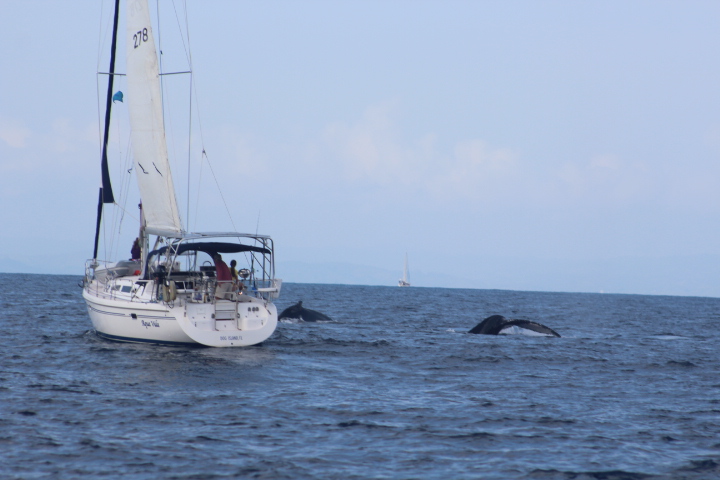
The next morning as we rounded Cape Samana, Humpback whales spouted off our bow. Aqua Vida, a few hundred feet in front of us, got the best show. I took photos from the bow pulpit:


The Luperon to Samana run is one of the thorniest of thorns on the thorny path (along with crossing the Mona Passage from Hispaniola to Puerto Rico). Even so, we got the weather window right and all went well. It was lots of motoring/motor-sailing, but we did have about 6 hours of very nice night sailing.

Once in Samana, we stayed at a marina for a few days and then crossed over to Bahia de San Lorenzo at Parque Nacional Los Haitises. Beautiful spot. The limestone formations remind me of the west coast of Thailand.


Bahia de San Lorenzo.

Exploring the Mangrove River at Los Haitises National Park.

The crossing from DR to PR (via the Mona Passage) turned out also to be uneventful. We did have a very nice 12-hour sail from the time we left Samana in the evening until daybreak, Also caught a good-sized Skipjack Tuna -- probably our best fish to date. We finally arrived the next evening about 10 p.m. for a 28-hour run from Samana to Boqueron.

Tuna sushi

For all the hassles we expected to experience with customs and immigration in the DR, most never materialized. Although different cruisers had different experiences, most encountered no problems or demands for "tips." One individual in Luperon demanded a tip and a Czech couple were charged for an interpreter in Samana even though they speak perfect English. For us, the bigger headache was in our home country. Puerto Rico ended up taking a whole afternoon because of Homeland Security red tape!

Currently we are enjoying ourselves in PR. We visited a coffee plantation, did some shopping and re-provisioning and are, generally, taking it easy.

Playa Salinas, PR. Nice anchorage.

Isla Caja de Muertos (Coffin Island), Puerto Rico.


Symbiosis and Utopia anchored at Coffin Island.


Saturday, March 19, 2016

One Of Our Favorite Anchorages


We've been in Luperon for two weeks now waiting for weather. It's turned out to be possibly our favorite anchorage to date.

When we arrived in the harbor (towed in during light winds by our new friends, Peter and Mary aboard S/V Neko), the earthy smells, green mountains and cool breeze were welcome after the beautiful but barren Bahamas. The picture telegraphed that the Dominican Republic is a real place, not just a postcard.

Luperon harbor
Leo, the manager at Puerto Blanco Marina, greeted us upon arrival and helped us (and Neko) through immigration and customs. Anyone who has read cruising reports on Active Captain or elsewhere (as we did) would have some trepidation about this procedure. In short, it's been advertised as a shakedown. We found it to be quick and relatively painless. According to Leo, things have been changing for the better with a new, honest commandante. The previous local chief of immigration acquired a reputation for being on the take.

Since getting here, we've spent most of our time in the harbor or at the nearby village, but we've also ventured out to Puerto Plata and to the "27 Waterfalls" (recommended!). A few boat projects and a lot of time to relax.

Miguel, Leo and Scott at Puerto Blanco Marina restaurant and bar
The marina is basically a single dock with only a few spots for transients. It's inexpensive and the restaurant (and the wait staff), very pleasant. It's not fancy, but very functional. Leo apparently has a long-term lease on the property, which had fallen into disrepair under the previous owner. He's making a concerted effort to renovate it. Miguel seems to be in charge of the restaurant operations and doing a fine job of it. The harbor itself is surrounded by mangroves and extremely well protected. If for some reason you couldn't get south for hurricane season, this would be the place to wait it out. Moorings are available for $2/day (that's not a typo!), or you could just anchor -- lots of room and the holding is reputed to be very good.

For anything from laundry service (cheap and excellent) to boat repair, "Handy Andy" is the man. Just ask, everyone knows everyone else here. When I first met Andy, he handed me a flyer with a list of his services and a phone number. I'm leery of touts, but Andy proved to be an honest broker and an all-around good guy. His English is not bad at all and he proved extremely helpful.

So, the final test for us is the check-out procedure. The DR does require you to acquire a despacio to leave each port, even if you're going to another Dominican port. Clearly it's a money-making thing and a bit onerous if you're on the receiving end, but that's the way it is. This part of the process could still prove aggravating, but we shall see.

The point of this post? Luperon has, in our view, gotten a bum rap -- or else, the problems it once had are fading into the background.

For anyone thinking of following in our wake, we give this place two thumbs up!

Saturday, March 12, 2016

The List That Never Ends ...

Here's a list of things that needed to get done/redone from our last passage:

-- Diagnose/fix engine problem. (Done. It was in fact dirty fuel).

-- Rewire electric bilge pump. (Done. A wire chaffed through, causing a short).

-- Replace broken top batten in mainsail (found some suitable batten material. Will cut and place tomorrow).

-- Fix all water foot pumps and electric water pump. (Manual foot pumps all remounted so that hopefully they stay put this time. Bought used electric pump at local marine store, but it doesn't work so need to return it).

-- Check alternator, which didn't seem to be charging. (Partly done. Need to double-check to make sure it's charging properly).

-- Clean bilge. (Partly done. Still looking for gallon size of white vinegar to finish the job).

-- Find new hose for manual bilge pump and re-plump. (Still looking for hose).

And, this is a fairly typical post-passage list of chores.

Tuesday, March 8, 2016

A Tale Of Whales, Waterspouts, Flying Fish And One Noble Cat

The punchline of this post involves a flying fish.

But mostly it's about whales, waterspouts, a bit here and there on deserted islands and lastly, the charity and kindness of fellow sailors -- in this case, Peter, Mary and Sophie aboard Neko.

... when last we left off, Noi, Scott and Doug were in Georgetown, the sailing capital of the Exumas. Noi was gearing up for the professional beach volleyball circuit and Scott was reveling in his new-found status as the Texas Hold 'Em champ of Stocking Island. Doug was enjoying both the rum punches and the Brazilian bikinis a little too much for his own good.

As much as we all liked Georgetown, it seemed time to move on. When we got what we thought was a long enough weather window to get to Turks & Caicos, Doug and Noi pulled anchor and we slowly motored out of the harbor, following our track back in order to dodge shallow coral heads. Our friends on Gratitude, Jeannie and Peter, were behind us and planned to go to Mayaguana, which was our own fall-back stop (it's about 40 miles closer).

It was a bit rough getting out of the cut, which it often is. Imagine trying to pour tons of water in or out of a small opening -- and then twice a day trying to pour the whole ocean in the opposite way. What is created is a bathtub effect right near the relatively narrow cut. At the wrong time of day and/or in the wrong kind of weather, it can quickly go from just unpleasant to downright dangerous.

We got farther ahead of Gratitude than we expected, demonstrating once again that the concept of "buddy boating," which sounds great in theory, almost always falls apart in practice. Both crews anticipated this, so it was not alarming. After a few hours we got a call from Peter and Jeannie on the VHF saying that they had a few issues in the rougher-than-expected conditions and had decided to put in at nearby Long Island. We had problems communicating though -- mostly we could hear them but they couldn't hear us. (We didn't find out until days later that after Long Island they subsequently decided on a more ambitious plan to go straight to Jamaica. They made it! Good show, Gratitude!)

About this time, we started to doubt that this very narrow weather window was going to be long enough for us to complete a two-plus-day passage to Turks & Caicos, or even to reach Mayaguana before the wind turned against us and we'd find ourselves motoring into a short (and unpleasant) wind-driven chop. Plan B? There was Rum Cay, a small island community that had suffered quite a lot during Hurricane Joaquin. But it would have us getting in after dark.

Although we have violated the rule about not approaching an unfamiliar harbor in the dark from time to time, it's not a good idea to tempt fate, especially in the reef-strewn Bahamas. The other option was Conception Island, which (along with Rum) was one of Columbus' stops in the New World. Today it's a land and sea park, somewhat similar to Waderick Wells. There was an anchorage there that offered good protection for the blow we were expecting, with winds clocking from north to northeast, east and southeast (the typical pattern of a cold front). We knew we'd be there for a few days without cell phone service and maybe no one else on the uninhabited island.


The anchorage at Conception proved a delight. We were the only boat there and, as we soon found out, the only boat on the whole island, save for a three-masted schooner anchored on the south end who left within hours of our arrival. We took the next day to dinghy ashore and effect a desultory exploration of the island, a fairly typical south Bahamas cay that nonetheless has a beauty all its own. It was wonderful having an island unto ourselves for a few days.

When the weather offered an opportunity, we decided to make a quick sail over to Rum Cay to stage ourselves there for a somewhat shorter hop to Mayaguana (we'd decided by then that maybe Turks & Caicos was too much in one go). 

Along the way, we caught a sailfish! When it hit the line, we knew it was something big. By the time we got it close for inspection, we were surprised that our reel and lure (thanks, Ardi!), had managed to bring in what is a major game fish. It was a Hemingway-esque moment for the crew of Symbiosis. Unfortunately, it is not a fish that is really good to eat. Strange that is, as it seems to be so closely related to the swordfish, which is of course on the menu at expensive restaurants. Much over Noi's protests, we cut the line and lost the lure. I feel bad that we couldn't remove the hook and lure, which could cause the creature some major inconvenience -- or worse. But, the prospect of landing the five foot (?) fish and dealing with the sharp bill to remove the lure (and quite likely killing it in the process) didn't seem worth the risk.


Rum proved not to be nearly as "devastated" as we'd been led to believe. Lots of houses and businesses still standing, although several of them were in the process of getting new roofs installed, no doubt due to hurricane damage. In any case, we did not go ashore and after a sleepless night due to a very unpleasant surge, we shoved off the next morning for Mayaguana.

Rum Cay.
Rum-to-Mayaguana went more or less smoothly. We got a few bites and nearly caught a mahi mahi, a fish we've been hoping to catch since we left the states. It hit hard, putting up more of a fight than even the sailfish had. It broke the surface a few boat lengths behind us and I (Scott) could see that it was easily as big as the sailfish, but of course iridescent green and blue. A beauty that would have fed us all for days. It was not to be. Moments later, it was obvious that nothing but a lure was on the line any longer. I saw a black-tipped shark swim by near the end of the line. It either took the mahi from us or got him after he wriggled free. Just another one of those stories "the one that got away" stories. Sigh.

Mayaguana is a pleasant little spot. We anchored on the south side in Abraham's Bay after motoring along a circuitous and coral-studded path from the western side. The people in the small isolated settlement are quite friendly and helpful. Doug arranged for a flight out. I arranged to get some diesel. A guy named Scully who is described as the local fixer-cum-ambassador in the cruising guides said he could scrounge up 10 gallons for us at $6 a gallon (the Bahamas premium plus a cut for Scully). Technically, we already had enough to make it to our next stop, which at this point we had decided would bypass Turks and lead straight to the Dominican Republic. If we had to motor the whole way, we'd probably make it. But the margin of error was tight and I felt better having the extra 10 gallons aboard for contingencies. The whole affair of actually getting the diesel ended up wasting much of an afternoon. Scully turned out to be not quite as reliable as we'd been led to believe. Anyway, we did eventually get it.

Abraham's Bay, Mayaguana

Next day, Doug was off on a plane and Noi and I returned to the boat and got things ready to shove off for the DR then next morning. We had decided to try the narrow southern cut that would save us quite a bit of time over backtracking to the west. However, at the last minute the skipper chickened out. It probably would have been just fine, but there was one tiny spot where the charts are unclear on the depth, which is obviously at or near a minimum for Symbiosis there. We just did not want to take a chance. Retrieving caution from the wind, we went back out the way we came in.

En route to Hispaniola we had an on again, off again, combination of good sailing, motor sailing (motoring with the sails up, which gives you an assist and allows you to burn less fuel) and plain motoring (yuck!). The seas were mostly calm and we had no real problems, at least initially. Nothing was biting, but that was OK, too.

In the Caicos Passage off the west side of Turks & Caicos, Noi spotted whales on the horizon! They were fairly far off, but we could definitely see them breaching and using their flukes to slap the surface. We are pretty sure they were Humpbacks, but can't say for certain. Seeing these huge beasts from one's own small boat is something we won't soon forget. It's a really different experience than seeing them on a tour. This is the open ocean -- just you and them! We never got closer than maybe 3 to 5 nautical miles from them (and we got the distinct impression they were actively avoiding us), but it was still a spectacular encounter!

Our next run in was with Mother Nature. We had missed a few squalls here and there, but on the second day out an ominous one loomed on the horizon and it looked difficult to skirt. Worse, we soon noticed waterspouts (seabourne tornadoes) forming on its leading edge. Right in our path! We motored hard to try to pass to one side of the storm. For some time it was touch and go, but the waterspouts disappeared and we motored through the squall, which actually turned out to be quite benign. We didn't even see 20 knots. Still, an anxious few hours.


One of the problems with planning a passage like this is how to time your arrival. Usually, you shoot for a morning landfall. You want to see the entrance and you want plenty of daylight to get in. This was the case for our planned landfall at Luperon. The problem is that the wind and waves are fickle. The rule of thumb is to plan to make 100 nautical miles a day. That's averaging 4 knots. If there's decent wind, or if we motor (or motor sail), we can easily do 5 knots (120 miles) and not infrequently, 6 knots. On a two-day passage, the difference between 4 knots and 5 knots, for example, is 40 miles, or about 10 hours. If you're purists (which we aren't), you would simply sail the whole way and either get lucky with arriving at exactly the right time or else heave to (stop the boat by using the sails on opposite sides) to wait for the right time to enter. Or you could try to sail, but have a rule that if your speed falls below a certain threshold, you turn on the engine. This is something we try to do, but even that doesn't always work out.

As we got closer to Luperon, it was obvious we needed to dial things back or we'd end up there well before daybreak. As a result, we had the engine barely above idle, motoring at 3 knots or so in fairly calm seas. About 25 miles out, I heard the engine make a funny noise. Then, it suddenly shut down. Shit. It was dead calm and we couldn't sail. We needed to make it in by the morning for two reasons: one being that the north shore of the Dominican Republic is notorious for getting very windy and very rough after about 10 a.m. The other was that a major cold front, with possibly 30 knots of wind and big seas, was forecast to reach us later that day.

I immediately suspected a clogged fuel line from dirty fuel. Just before we left Mayaguana, I changed two of the three in-line fuel filters because I suspected we may have gotten some dirty diesel in Georgetown. I checked the first filter, designed to catch the big stuff, and it looked clean. But by opening it up to inspect it, I was inevitably introducing air into the fuel line, which meant the necessity of re-bleeding the engine -- a somewhat time-consuming and tedious process. In any case, I hadn't made a definitive diagnosis of the proximate cause of the shut down, something that might take hours and at worst prove impossible. We needed to get into port.

I issued a cautionary "pan, pan" call on the radio -- an announcement that says you're in trouble, but falls well short of a "mayday," which clearly was not our situation. In short, we needed a tow into Luperon and were hoping a fisherman might help us. No one answered.  I then issued a "securite" -- an informational broadcast announcing our position and that we were adrift. This was to make sure no one thought we were underway and hit us. At this time of day, one's navigational lights should tell the story, but on a small boat, there really isn't a proper lighting configuration to say "I am dead in the water." After that, I went forward to put up the sails in hopes of getting at least a breath of air and making some progress toward Hispaniola. We were still too far out to reach anyone on land by radio, and besides, it was only about 1 a.m., so who would be listening at that hour?

That's when Noi, who was at the helm, noticed a catamaran, Neko, on the AIS (a device that tracks boats via a VHF signal). I knew that boat! Although I'd never met skipper Peter Malloy and his wife, Mary, in person, I had interviewed Peter via email for a story I had recently finished for an upcoming issue of Cruising World. Noi thought Neko was going in the opposite direction, perhaps leaving Luperon for points north. There was a chance the skipper had the skinny on who to contact to get a tow once we were in range of Luperon. I called Neko on the radio and Peter answered. He said he'd heard our pan and securite broadcasts and was just sorting some things out on his boat before calling to ask if he could assist. In fact, he too was heading for Luperon, trying to get ahead of the same cold front we were hoping to beat. 

Peter said he was reluctant to tow us 25 miles. It can be difficult or dangerous and hard on his engines, which were after all designed to propel one boat, not two. I would have had exactly the same concerns if our situation had been reversed. But as we discussed it, Peter said he'd give it a try. He would tow us to the harbor; however, like us he'd never been there before and didn't want to try to bring us all the way through what looked on the charts to be a narrow and intricate entrance. He was just being prudent. I would expect nothing less.

I went forward to take down the mainsail and discovered it jammed at the top! We needed to get that down, as having it up in any kind of wind could have seriously complicated the tow. I called Peter and informed him of the problem and we concurred that it was better to not try a tow unless I could get the main down. If I forced it down the track, I risked ripping it, but it seemed at the time we needed to take that risk. We could always repair the sail later. Then I had an idea. I attached a line to a cringle (ring) on the sail's luff (front side) and ran it down to the winch that is normally used to raise the sail. I cranked it and the sail popped and began running down the track. Whew!

I called Peter back and asked if he was still willing to give it a try. He said yes, maneuvered up to us and after one failed try we managed to toss Mary a messenger line and send over the tow rope. The several-hour tow to Luperon was mostly uneventful except for one moment when a flying fish breached the surface, glided under the bimini and grazed my face before landing with a squish on the stern deck. Yep. You can't make this stuff up!

Our heroes aboard S/V Neko towing us into Luperon.
We got close to Luperon, called Puerto Blanco Marina on the radio and got an answer from a very American-sounding fellow. Thomas said he'd get in his skiff and come out and take over the tow from Neko. It turned out that this fellow, aboard his boat, Ciganka, was simply a long-term liveaboard in the anchorage. He showed up along with a swarm of other dinghies to assist us in getting in. It was quite a surprising and initially confusing scene. At first, I had no idea who these people were. But it all went like clockwork from there. Neko dropped the tow line and Thomas hip-towed us in with his skiff and 15 hp outboard with Symbiosis providing the steering.

The anchorage that unfolded before us is without a doubt one of the prettiest we've ever seen. Much different than the Bahamas, this was a mountain-and-mangrove ringed spot that is simply breathtaking in its beauty. And extremely well protected. It felt like a spot we wouldn't mind spending some time in.

Luperon harbor.

Home. For awhile, at least!

Raising the Dominican courtesy flag!

Wednesday, February 17, 2016

Camp George Town!

View from Monument Hill. Symbiosis is there -- somewhere!
It's been more than a week since we arrived in George Town. We are enjoying ourselves!

If you know anything about the Bahamas, you know that George Town is a mecca and a sort of southern terminus for boats traveling in the Exumas. Some go farther south, as we intend to do, but most hang out here for a few weeks or months and then slowly make their way back north.

The anchorage has a very elaborate morning radio net and the announcements read like a kids' summer camp -- volleyball, poker, yoga, lectures, etc. Amazing, really.

We've been in two anchorages thus far: the first was just off Goat Cay on the western side of the harbor. We waited out some relatively light westerlies there and then hopped over to the other side, in the lee of Monument Hill, where we've been ever since. Off Monument Beach, as it's known, has been ideal for protection from the north and northeast, which we've had a lot of recently. We are about to get even more from that direction, with two days of 30 knots forecast for tomorrow (Thursday) and Friday.

We expected to see our friends, Peter and Jeannie on Gratitude when we arrived in the harbor, but despite repeated attempts to contact them via VHF, we couldn't -- at least not initially. The harbor is chock-a-block with boats in various anchorages, so we had no idea where they might be or if they had even arrived. We finally gave up after a few days of trying on the radio and then we heard a call from them! Apparently they had some "issues" and were delayed. We left it at a vague promise to "see you in town," but we have yet to see them. Hope we meet up again before one or the other of us shoves off.

Meanwhile, at Monument Beach we ended up anchoring next to The Norm, a catamaran that belongs to Rhonda and Bruce, a very interesting couple that we first met in Charleston. We've enjoyed re-connecting with them and they've been most helpful -- their boat has an enormous generator and water maker; they've been saving us a lot of trips into town for water! They also gave us a whole flash-drive full of movies and TV. We had never seen Game of Thrones, but in the past week we've binge-watched two seasons. Count us among the newly converted.

Last night we also were over for sundowners with friends on DiscoFish. We met Marc and Joanne in Nassau. They are bound for the BVIs, so we are likely to keep bumping into them as we head in the same general direction.

Besides all the fun, I have managed to get some writing done too. Before we left Emerald Bay Marina, I pitched a story to Cruising World and they accepted. I just finished writing it yesterday after several days of reporting. It's slated to appear in the May issue. So look for it!

Finally, our good friend Doug Reynolds from Magothy Marina arrives today. Doug is going to sail with us to the Turks & Caicos. His schedule is a bit tight and (unfortunately) it's looking like it may be a week at least before we get suitable weather again for that passage (which might be multi-stop or straight-through -- we're not sure yet). Hope Doug likes George Town as much as we do!