Sunday, August 21, 2016

We Was Robbed!

Eric with his returned passport on S-dock at Port Louis. You can see how easily accessible this area of the marina is to St. George's harbour entrance in the background. 
Firstly, I promise there's a feel-good post to follow this that will detail our week with Eric in Grenada.

However, there is one unpleasant incident to report:

Friday evening, a young woman, whose name we later learned was Sinatra (yes, like Old Blue Eyes) approached Noi at the Port Louis Marina pool. We'd been staying at the marina since the 7th, in anticipation of Carnival and later, for Eric's arrival. It was first a matter of convenience and secondly -- especially for Carnival -- one of security. The latter turned out not to be the case.

Sinatra said she had discovered Noi's identification and debit card in a bag on the street near her home in a town not too far from the marina. She said she'd assumed Noi was a foreigner, and therefore might be at the marina. Armed with Noi's photograph, she asked at the marina and found us at the pool. Sinatra promised to return with the items and did not ask for a reward.

Noi was not even aware that her wallet was missing. The last she remembered it was in a backpack in the boat and hadn't been touched in several days. When we returned to the boat, we discovered that the pack with the wallet was indeed missing (it contained the equivalent of a few hundred US dollars) and, worse, another pack was also missing -- one that Eric had brought with him that had contained his passport! This happened late on a Friday and Eric was due to fly out very early the following Monday.

While we were waiting for Sinatra's return, we cancelled the missing debit card and started looking into pushing Eric's flight back to give us time to get a temporary passport. Noi went to report the incident to the marina security.

The bags in the boat had been sitting in a corner of the saloon since Eric arrived. Neither of them had moved. We began to realize that a curious incident several days earlier had probably been a sign of the break-in that we hadn't recognized at the time. A padlock that we use to secure the Lexan companionway slats was acting strangely. It is a combination lock that had become hard to open and had actually slipped a digit. The original combination no longer worked. Padlocks going bad is a common occurrence in the salt air, so it was not a surprising development. Afraid of getting locked out, we got a new lock the next day and threw the old one out.

Later, on closer examination, I noticed the latch was slightly bent to one side, as if someone was throttling it as they tried to prise open the lock.

We are therefore quite sure that the lock was broken, the boat entered and bags stolen. It was odd that nothing else seemed to be disturbed, not even a laptop or iPads that would have been in plain view once someone entered the boat. The only thing we can imagine is that they wanted quick cash and either realized one of the bags had a wallet or just assumed they both might. In any case, we know for a fact that the bags had not left the boat in the previous week, so they had to have been taken from there.

I have a hypothesis about exactly how it must have gone down, which I will detail below.

When Sinatra returned with the items, she had two other young women, Angel and Cassandra with her. She explained that one of them was a Grenadian friend and the other a friend visiting from Trinidad. Noi gave Sinatra a few dollars for her trouble and asked if she had any idea about the passport, promising dinner for the three women if they could help find it.

Obviously, there were natural red flags here when it came to enlisting help from the women. But, the authorities seemed likely to simply take a statement and satisfy their bureaucrats (some things are the same the world over!). The chances that the passport would be returned seemed remote, at best.

Sinatra said she thought she knew who might have done the robbery ("drug people" in her neighborhood) and that she could make some phone calls to see if she could get the passport back. After about an hour of calling (while I talked to security personnel at marina), Sinatra said she had heard that a police officer had seen the passport on the street, picked it up and returned it to the station. Apparently someone in her town had seen this happen, or else the police officer had asked around if anyone knew about the passport. Not sure which.

Eric with Sinatra, left, Angel and Cassandra (or Cassandra, Angel)


The marina security requested the the three young women answer a few questions in the office and they did so without reservation. The police were called and two detectives from the Criminal Investigation Division showed up about 15 minutes later and also took a statement from me, Noi and the three women, including Sinatra.

When asked if the police had found a passport, the detective said "yes." Presciently, Eric's mom had photographed the faceplate of his passport before he left the U.S. and I had it on my phone. I scrolled back to it and showed it to the officer. He immediately recognized the passport! Whew! What a relief. The women gave each other a high-five.

So, because it was a weekend, we had a bit of a hassle getting the passport back in our possession, but eventually did. We treated the women to a dinner at the marina and they seemed quite nice and friendly. I tried inquiring about some of the odd details of the incident, and their knowledge of it, but with the thick Creole accent, I didn't get very far.

So, here's what I think happened:

First, let me say that when we were given our slip assignment on the 7th, we were placed as far out in the marina as it is possible to be, closest to the water approach. The dock (S-dock) is normally reserved for megayachts, but it wasn't filled, so they put us and a few other decidedly un-megayachts out there. At the time, I was a bit nervous about security in that spot, especially the ease with which someone could dinghy in from the harbour and land at the dock. But, at the time I dismissed it as paranoia.

Subsequently, I did see a few dinghies land there full of people who were obviously not from the marina, but I didn't think too much about it, having already satisfied myself that we were safe. On one occasion, I did see them chased off by marina security; however, on another, they landed and entered the marina. I probably should have reported that incident, but did not. It occurred during Carnival, and the people in the dinghy appeared to be revelers. I figured they meant no real harm.

So, my hypothesis is that sometime in the week, while we were off on an island bus tour or out snorkeling, someone pulled up in a dinghy, quickly jimmied the lock, possibly with a crow-bar, grabbed a couple of items and were off before security noticed anything amiss. Why they put the slats back in or re-locked, I don't know. Perhaps in hopes that we wouldn't immediately recognize what happened (and we didn't!).

I have a few thoughts about Sinatra and the other two women. Sinatra said she was just trying to be a Good Samaritan, and I would like to believe that's true. I am not sure what her motive could have been to return Noi's identification. If she and/or the others were directly involved in the burglary, it seems to me the reward that she received (and had no guarantee of receiving) was too small to risk getting caught. And, the promise of a dinner to help get the passport back does not seem a great enough incentive either. Also, it had been several days since the actual robbery. If the thinking was to return the identification in hopes of a reward, why wait so long? She had no reason to believe it would have taken us so long to discover the missing items and also no reason to think we might still be in the marina.

A few things, however, leave me with questions:

How did she know to look at the marina? There is a large medical college on the island with lots of foreign students. Noi could have been one of them. Sinatra's town, however, is closer to the marina. So, it might have been a logical place to look. Now, obviously Sinatra did know a few ins and outs of the way these crimes go down. She might also have known that foreign yachts are a target.

She said she found the identification the same day she tracked down Noi. Why was the identification in a plastic bag? We don't know, but it apparently saved most of the items from getting wet in several rain showers that had occurred during the week. The photograph of Noi that Sinatra says she used to track her down did have some water damage, which seems to bolster the young woman's story. Otherwise, if she was the thief and meant to try to return the identification for a reward, it would have been in her possession since the robbery and therefore, presumably, dry. The passport also had no water damage, but it could have been picked up by the officer the same day as the robbery. The police did say it had been in their custody for a "few days."

We probably won't ever know anything else. I will say that Port Louis Marina security -- after an initial defensiveness -- was ultimately quite helpful. I don't really blame them for what happened; I think it happened quickly and it was probably unavoidable. I would recommend some way to better monitor the outer dock, or to keep intruders from the water away. I don't know how that could be accomplished, but I am no expert in security matters, either.

I would also add that I don't think the three women were directly involved, but they almost certainly knew people who were. And, maybe they simply didn't feel like "ratting" anyone out. It might have even been dangerous for them to do so. Under the circumstances, I can understand that. If they had simply kept the items in their possession in hopes of a reward, they would have tried to return them earlier. Further, the fact that the picture of Noi was water-damaged lends credence, in my mind, to Sinatra's story of finding it on the ground.

Today, we are off to buy a better padlock!

NOTE: An earlier version of this post referred to the lock being "jimmied," however on further reflection that is not the right term for what we think happened. Jimmied implied that it was picked, which as a combination lock without any keyway,  would have been impossible. We think it most likely that it was leveraged apart, perhaps with a crowbar. This might also explain the bent latch.

Friday, August 5, 2016

Home, Sweet Home. For A While At Least


Noi's morning dip in Prickly Bay.
We are finally getting settled into a sort of routine here in Grenada, our new temporary home.

Yes, we still watch the weather, but not with quite the same urgency as we did a few weeks back, when we were always searching for the next little window to set off for our next landfall. That's perhaps the biggest difference in our lifestyle now, that we have sort of lost our sense of urgency. Not necessarily a bad thing.

Instead, we get up each morning, put on some coffee, listen to the morning cruisers' radio net, take a quick salt-water dip/freshwater rinse and start planning our day. There are always cruiser friends who are showing up or the ones already here who have some activity planned that we might tag along on. Also, I am working on a few freelance pieces, one for the Annapolis free magazine SpinSheet, which has been a great outlet, actually. The other is for Cruising World. I can do that work aboard, but it's nice to get out of the boat -- so, that often means a lazy afternoon at our favorite Internet cafe at Prickly Bay Marina. The place has strong wifi (unusual on the cruising circuit) and power points at each booth. Plus a bar, of course. There are a dozen other similar options here, too. The place is packed with cruisers and the locals have definitely figured out that there's money to be made on us. Good for them.

In a few days, we will go back to Port Louis Marina. Carnival -- the annual bacchanal celebrated in the Caribbean in various forms, according to the island -- starts on Sunday, and we want to be in a secure location and closer to the action by then. Theft from boats has been an on again, off again, problem here, and especially so when everyone is ashore for the big Carnival events. We had already planned to go into the marina for the arrival of our son, Eric, the following week, so thought it made sense just to extend it a few days to get the marina's security staff keeping an eye on Symbiosis.

Visiting West Indies Beer Co. with Debbie and Larry Gaddy from Tropical Blend.
Speaking of security, I should mention that there was one very unpleasant incident in the past week in an adjacent bay to ours (we are in Prickly for the moment). A cruiser walking his dog was approached by two armed men (it's not clear if they were Grenadians or off islanders) on the beach and forced back to his boat, where his wife was aboard. The men, apparently on the lam from the authorities, demanded they be taken on the boat to Puerto Rico. Coincidentally, the boat's engine was not working, but the men demanded the boat be sailed there -- easily a three to four day passage. I won't go into much more detail except to they are alive and to add preemptively that no, having a gun aboard (I assume they did not) would not likely have helped them. In fact, they'd probably be dead now. You can read a detailed report here under the Grenada item dated July 30, 2016. In any case, these things must be kept in perspective. Yes, it was an unfortunate incident but seems to have been a one-off. Crime occurs all over the world. Just because we are in "paradise" doesn't mean we couldn't be a victim. But, it could just as easily (perhaps more easily) happen in the U.S.

Nutmeg. The outer red shell is mace. Grenada is the nutmeg capital of the world.
Mangoes. Another favorite in the islands.
Anyway, we are very excited about Eric's arrival. We haven't seen him in 10 months and we have lots of things planned that we hope he will enjoy: tours, waterfalls, river rafting, snorkeling. We will post an update soon on Carnival and Eric's big adventure!

Thursday, July 14, 2016

Stuff That Didn't Work

Here's our shit list of useless gadgets.  Check back for updates!

"Eco-friendly" jerry can nozzles: The only thing I can conclude is that an engineering intern was given an overnight deadline to design the "environmentally friendly" nozzle on these cans. Hopped up on Mountain Dew, he or she sketched it out sometime between 3:30 and 3:45 a.m., while simultaneously playing online video games. The nozzles are pretty much guaranteed to self-destruct on the very first use. I have lost springs and other small pieces into the fuel tank as I watched these nozzles disintegrate before my eyes. Bad enough, but they are about as environmentally friendly as the Exxon Valdez. They leak fuel all over the place, creating a far bigger mess than the old-style (non-environmentally friendly) nozzles. Worse, there's no alternative. Try finding the old nozzles anywhere in the Americas. They're all gone. And no, this isn't the EPA's fault. Nothing wrong with mandating spill-proof nozzles. It's the manufacturer's fault for a truly crappy design. This isn't rocket science, folks. Here's a video (not mine) showing the gas can fail.

Those freakin' nozzles!
Dyneema: I was persuaded that this high-tech synthetic stuff was just the thing to replace my aging stainless-steel lifelines. It's been nothing but problems for us. It might be good for other applications, but for lifelines, there's way too much stretch in Dyneema (which goes by other brand names, too). Expensive stainless fittings spun out and dropped overboard. I wish I had stuck with stainless. I was told by others that the Dyneema would reach an equilibrium and stop stretching. But, we haven't found that point yet -- a year after installation, it still stretches (a lot!) each time I give it a tug. Then, all the lifeline fittings must be readjusted. It's worth noting too that it cuts much more easily than the manufacturers' claims. I have heard it stated that it's impossible to cut a fully stranded length with a knife. Nonsense! A sharp knife cuts Dyneema almost as easily as any other rope. And a heat gun cuts through it like butter. All in all, I find the claims for this synthetic wonder-stuff to be highly overrated. Again, it's probably fine for some applications, but if you need something that won't stretch, this is definitely not the right material. As for strength, I would be cautious on that score as well.

Iridium satellite phone: Yes, technically it worked. When it got a fix, an event that could not be counted on. We used Ocens for the service, and text messages (supposed to be cheaper) never worked properly. Only the texting number would display, nothing else. Our shore-side contact ended up racking up a fortune in additional charges, which we weren't expecting. Communication was so iffy, we just gave up on the phone. Not worth the cost ($700) of the service package or the $700 phone (used), in our opinion. If we had it to do again, we would have spent the money on an upgraded SSB system and a Delrome Inreach, a more sophisticated version of our Spot Messenger. The Delrome allows inexpensive satellite texting that seems to be quite reliable. And really, that's all we would have needed.

Uniden Atlantis 200 hand-held VHF: Thought I got a good deal on this unit, which has the option for standard AAA batteries. Also, it is submersible. Except, it never worked right from the start. One push-to-talk, even at low power, and new batteries (or fully charged rechargeables) were nearly down to zero. A few months later of non-use and the unit just crapped out altogether. No display, no nothing. Uniden customer support was unhelpful.

Maglite flashlights: We bought one of those expensive police-style Maglites, thinking we were getting something for our money. Nothing could be further from the truth. The light lasted a few weeks and even then was always dim, even with new batteries. It proved pretty much useless. I have talked to several other cruisers who had the same experience with Maglites. We changed it for an LED flashlight (Defiant is the brand) that's proved bright and reliable.

Marina wifi: It doesn't much matter where, it just didn't work well. Often the signal was not strong enough to reach our slip or anchorage, regardless of how it was advertised. Even if it did reach, the bandwidth was typically very narrow and not infrequently, completely useless.


Holy Hand Grenada! We Finally Made It


It's been nine months and nearly 3,000 nautical miles under the keel, but we finally made it to Grenada, the southernmost terminus of our planned travels in the Caribbean.

On Tuesday, we crossed a 35-mile stretch (appx. 7 hours) from Bequia, St. Vincent, to Tyrell Bay, Carriacou, Grenada, along with Larry and Debbie on buddy boat Tropical Blend. Although Carriacou is still about 30 miles from our final anchorage, we are officially in the country.

First let me back up: I see our last post was filed from Martinique. From there, we crossed the Martinique Channel to Rodney Bay, St. Lucia.

Thanks (or, no thanks) to a few recent attacks on cruisers in St. Lucia, we opted for staying in the local marina, where there's security. Probably nothing to worry about, but it wasn't too expensive, so why not? From there, we rented a car with Larry and Debbie and explored the island, including the famous dual peaks known as the Pitons.

Active volcano at St. Lucia

St. Lucia
Sailing south just 10 miles, we arrived in Marigot Bay. Wonderful spot. Nice protected bay and a resort open to anyone renting a mooring there. Snug as a bug.

Marigot Bay


Next day we set off for Bequia in St. Vincent & the Grenadines. If anything, St. Vincent enjoys (is that the right word?) a worse reputation than St. Lucia for crime. However, Bequia, a small island to the south of the main island, is considered quite safe.

Admiralty Bay there proved a tricky anchorage. The holding is good once you find the right spot. But finding a patch of good sand to drop the hook in is the hard part. After we anchored, Noi set out with snorkel and mask and checked to make sure we were properly set. No dice. She reported that the anchor was laying on its side in soft shell. So, we pulled up everything and tried again. The second time it set well.

Noi diving on our anchor at Bequia.

Wind-wise, the bay is not very well protected. We got gusts up to 35 knots blowing through the anchorage. Not a problem given the good anchoring.

The island is one of the few places still allowed by the International Whaling Commission (IWC) to harvest cetaceans. The quota is four whales a year, but it's not clear how many are actually being taken -- it could be less or more. The locals sell scrimshaw made from whale bone as souvenirs (we didn't buy any). Looks like mostly pilot whales, but again, there's no way for us to know.

From Bequia, it was on to Carriacou. Seven hours. Conditions were better than we expected. The sprinkling of islands known as the Grenadines that dots the route offered us a little protection from the swell and waves, which weren't too bad, in any case.

So, here we are at Carriacou. Another lovely little anchorage. Small town, but lots to do and a very nice introduction to Grenada.

I know that's not a very elegant post, but the wifi here, as usual, is iffy. Just wanted to get this on the record.


Friday, June 24, 2016

Musings On Anchoring

Le Marin, Martinique. The largest stand of deciduous aluminum we've seen so far.
Over the years, we've gotten used to being vigilant of having enough water under the keel as we approach a new anchorage. In the Caribbean, we are learning that anchorages can also be too deep.

Symbiosis carries 200' of 3/8" chain to go with our Spade anchor. But we've been encountering anchorages that are 30 to 40 feet at the shallowest accessible points. That means a 7-to-1 scope is not even possible in some cases.

Fifty more feet of chain would make a difference, but when we purchased the rode last year, the extra weight in the bow and the added expense of additional chain didn't seem worth it. Now, we wish we had more.

A few weeks ago, we anchored on the edge of a mooring field in Guadeloupe. When we dropped the hook, we had plenty of room with the prevailing easterlies. A squall came through about two hours later and all was well. But when the wind abated, the boats went all whopperjawed (as my father used to say) and we ended up uncomfortably close to a French catamaran. The owner and I kept eyeing each other. We'd have moved if there had been a place to go, but where? Anything closer to shore was chock-a-block already and anything farther offshore dropped off precipitously. The wind soon shifted and there was no issue, after all.

Before a squall moved in, we witnessed a 50' pilothouse cutter that began dragging with no one aboard. We watched for a while hoping to see the owner dinghy out to rescue his wayward vessel. As the boat drifted farther and farther out, I got a knot in my stomach and called a "securite" on the VHF hoping the owner, who was obviously ashore, might have a handheld with him/her. Nothing. I called several times. I thought about trying to get out there and do something -- but that's a dicey proposition. Some people would not react kindly, even if it was obvious we were trying to save their boat. For the record, I'd rather have my boat than my pride, but that's just me.

Now we are in Le Marin, where we have seen the largest concentration of sailboats anywhere, and that includes George Town, Bahamas! We've heard there are 700 charter boats (mostly catamarans) alone, let alone all the privately owned boats. The lagoon is full of shoals and packed with moorings that are all taken up by the locals, leaving room to anchor only on the margins. Based on our initial attempts to lay down our Spade, we were not encouraged. The Spade almost always catches on the first try, but twice we didn't get a good set. Finally, as we were powering back to set the anchor the second time, it caught. Since then (a few days ago), we've had no issues.

(Adding this in circa Aug. 2016. Here's a great video discussing some of the issues associated with deeper-water anchoring)

ActiveCaptain reviewers generally rate the holding here as "excellent" to "good," but I think there's a bit of anchoring inflation going on.

Thursday, June 23, 2016

Dominica And Quelques Iles Françaises

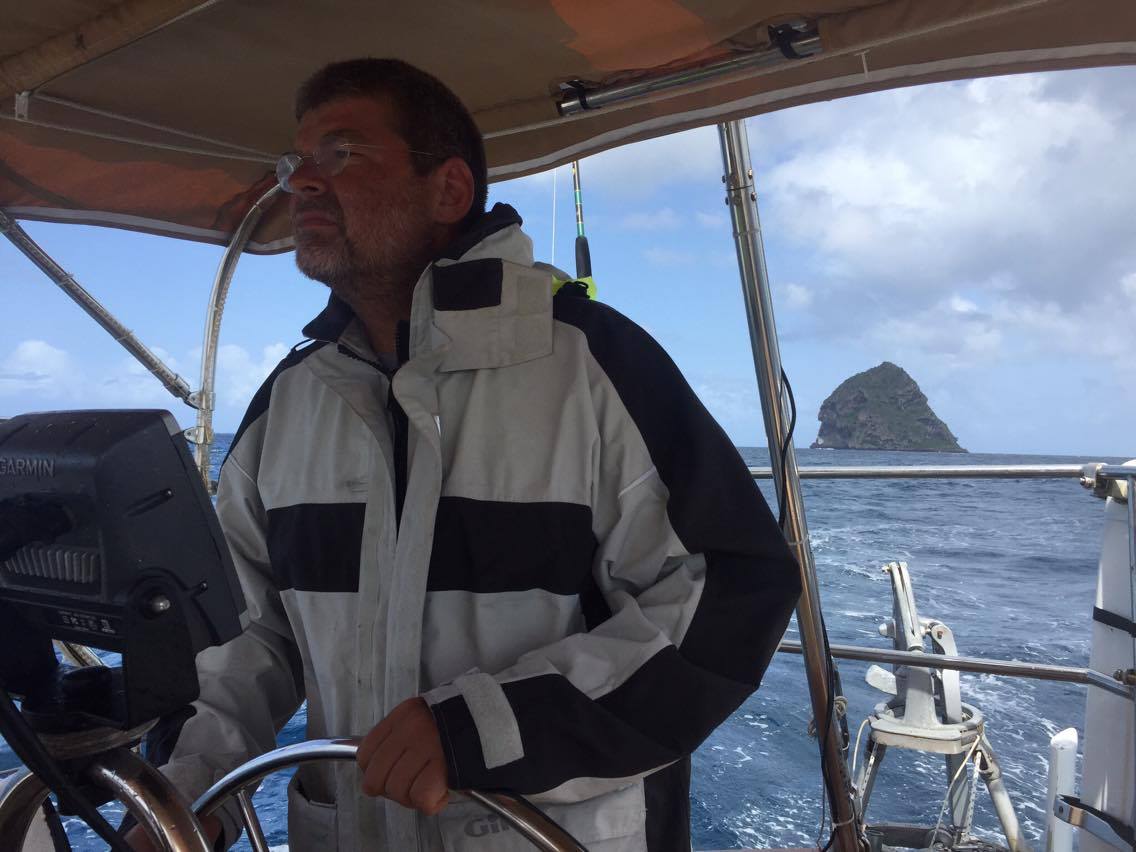
The famed Diamond Rock in the background. Southern Martinique.
We left Frank and Diane at Antigua as they were busy decommissioning Utopia for a summer and autumn on the hard. They are flying back to New York, where they will rest up and spend some time with family. We really enjoyed cruising with those two and will miss them. We did a lot of exploring and crossed some potentially nasty stretches of water together. Hope we can catch up when their season resumes circa December.

Today, we are anchored in Le Marin lagoon in southern Martinique. We've been traveling in company with Larry and Debbie on the trawler Tropical Blend since leaving together (coincidentally) from Antigua en route to Guadeloupe. I say coincidentally, but really there's not much serendipity about such things -- everyone is looking at the same weather and when it looks good (on average about one day out of a week), most people scatter to the winds.

We seem to share some of the same interests and outlook with Debbie and Larry and under normal conditions their Nordhaven 43 and our Tayana 37 seem to make about the same speed whether we are sailing or motoring. So, it's a pretty good match all around.

On the Antigua to Guadeloupe run we were both struggling a bit against short chop. At one point on the passage, Noi turned around and noticed several of our plastic jerry jugs drifting off into our wake. Somehow they'd worked loose from what I thought was a foolproof tie-down system I had engineered before leaving Antigua. The conditions would have made it difficult and/or dangerous to retrieve them, so all we could do was get on the VHF and warn Tropical Blend -- about a mile behind us -- not to run them over. Debbie had already caught sight of them and remarked to Larry about how well marked the fish nets were, as normally they are little more than a couple of plastic water bottles lashed together.

We arrived in Deshaies and checked in. It was probably the simplest clearing of customs and immigration we have ever had. The whole thing was done on computer in a local souvenir shop amid women's swimwear, hand-made bracelets and various bric-a-brac. The proprietor/customs agent didn't even stamp our passports! Deshaies is a cute little town, "little" being the operative word.

We didn't get much exploring done in Guadeloupe, but hope to do so on our way back north in the winter. However at the next island, Dominica, we took a few tours and got to see quite a lot. It's simply spectacular -- lush with flora of every variety. In fact, Noi and I agree that it's our favorite spot thus far. We went up the Indian River, which flows into Portsmouth harbour, which was fascinating. Among other things, some of the scenes from one of the Pirates of the Caribbean movies was shot there. We also took a driving tour with Larry and Debbie around the island, including the Atlantic Coast -- a trip which left us awed in the true sense of the word.

Post-card perfect: the stunning windward coast of Dominica.


When we arrived in Portsmouth, we got our first taste of the "boat boy" culture. As we approached the harbour, we could see a small yellow wooden skiff loitering at the edge of the bay and we were soon approach by Titus on Lawrence of Arabia. Titus offered to show us a mooring and to help with any arrangements for tours, as well as the daily necessities, such as water, ice, fuel, etc. Later that day as we dinghied back from clearing customs and immigration to our mooring (quite some distance), our tiny outboard quit and could not be restarted. I was fully prepared to row back, but when a man named Bonti in a black boat offered to tow us back, that suited me just fine. We offered him the equivalent of USD$5 for his trouble and inadvertently accepted a guided river tour from him. I suspected this was going to be a problem, and it was. Next we saw Titus, we tried to explain the arrangement, but he was having none of it. That's not protocol and Bonti was an usurper, he insisted. It finally got straightened out, but not without some hard feelings on Bonti's part.

Indian River, Dominica.


A few days after arriving in Portsmouth, I was sitting in the cockpit of Symbiosis when the most derelict-looking small sloop came peeling down the bay, expertly sailed between the moored boats by a scruffy 20-something in a straw hat. The 27' boat -- topsides streaked with black marks -- belonged to single-hander Sean. Sean, we later discovered, had sailed west from San Francisco seven years earlier and was now three-quarters of the way around the world. We had him aboard for dinner one night -- a likable enough guy, but at nearly 30 exhibiting the quirks we've started to recognize in the long-term solo sailor. Let's just say that reintegrating with "the real world" (whatever that is!) would be difficult for him. He doesn't seem to be in any hurry to do it, either.

Soursop. A peculiar but delicious fruit. Portsmouth, Dominica.
On the same day, our dinghy worked loose from a perfectly tied clove-hitch and started drifting out of the harbor. Noi spotted it and yelled instinctively "Get it!" Without thinking, I dived in and swam as hard as I could toward it, which for me is not very fast. But with the wind and current heading out, I soon realized it was a lost cause. When I saw a neighboring boat launch its sailing dinghy to recover our hapless dink, I turned back with some relief. Now, however, I was fighting the wind and current on the return. I barely made it back, grabbing a line Noi had thrown for the last few feet.

Jahn returned our dinghy and we decided to repay the favor with an invitation to sundowners. Jahn has been sailing the Caribbean islands for the past dozen years and turned out to have some valuable insights for us. He also has bought a small parcel of land on Dominica and, along with his wife (who returns to Germany for several months a year) expected to settle there eventually. He took Noi, Sean and myself out to see the land and we helped clear out some wild lemongrass for some new plantings.

From Portsmouth, we hopped down the coast with Tropical Blend to Roseau (pronounced ROSE-oh), the capital. En route to Roseau, just 15 miles down the west coast, we managed to rip our mainsail again, this time straight across -- a tear that encompassed the old repair and then some. It was my fault (Scott's). I released a cam cleat that holds a reefing line, but didn't notice that it had somehow reset itself while I was raising the main. When I felt resistance, I should have stopped cranking the winch, but I didn't. We've swapped it for our old backup main and are planning to have the repair down in St. Lucia.

After a few more days, it was off to the French island of Martinique. The best part about that passage from Dominica to Martinique was finally getting our Aries windvane self-steering to work! Sean and Jahn both had experience with windvanes and gave us a few pointers to make the linkage from the vane to the helm work. I (Scott) experimented with it and did some tweaking. After about 20 minutes of fiddling, it worked! It steered the whole way on a close reach. Here's a video of the Aries in action!


Before we departed Portsmouth, Jahn had insisted that St. Pierre in Martinique was a decent anchorage. But reading the reviews on Active Captain was not too encouraging. There is a very narrow shelf suitable for anchoring very close to shore and then a steep drop off into quite deep water. The reports of holding were only "fair" with caveats about dragging anchor. If the anchor dragged and fell off that steep ledge, it would obviously not re-set itself. Worse yet, it would probably be unrecoverable. But the good ship Tropical Blend was keen on going there -- it would make the trip from Roseau more manageable rather than going all the way to Martinique's capital, Fort de France on the southern tip of the island. So, we decided to try it. There was one report of the nearby beach being a better anchorage and while doing some research in other guidebooks, Larry also stumbled on this alternate spot at Anse Turin. It promised a much wider shelf with sand and mud and good holding. It turned out to be an excellent choice. The beach was not too far from the town and the holding was indeed very good. The only problem we had was on Saturday morning when some local fishermen asked Tropical Blend to move so they could run their enormous net out. Apparently Symbiosis was OK and Larry and Debbie just moved their boat over a few hundred feet.

St. Pierre is a charming town. It has gradually recovered since a massive and sudden depopulation in 1902, when a volcano (Mt. Pelee) erupted hot gas, killing all but two of the approximately 30,000 residents -- one of them a prisoner whose cell apparently saved him from death. There was little or no lava flow, however, so the volcano had the effect of a neutron bomb, wiping out the people but not the buildings. Now it is again a going concern. A bit sleepy for sure. "Quaint." The Saturday vegetable market is a great place to stock up.

From St. Pierre, we made another (squally!) jump down the coast to Grand Anse d'Arlet, a beautiful little bay with an abundance of sea turtles. From there, we rented a tiny Renault Clio with Larry and Debbie, and with yours truly at the helm, made our way into Fort de France for some major-league victualing.

"A real slog" from Grand Anse d'Arlet to Le Marin, Martinique. Photo courtesy Tropical Blend.
Then it was on to Le Marin. We expected it to be a short, easy passage down the coast, but it turned out to be a real slog. Steep and confused chop, wind and squalls. But we finally made -- wind on the nose nearly the whole way. We hope to depart from nearby St. Anne on Sunday or Monday for the 25 nautical mile passage to St. Lucia.


Saturday, June 11, 2016

Does It Get Better Than This?

Where have you been? Where are you going next? Those are the most common questions you get after being introduced to a fellow cruiser. The query about what you do (or did) for a living might take some getting around to, if indeed it ever comes up at all.

When we told folks in George Town, Bahamas, that we planned to "keep going south" and do the Eastern Caribbean down to Grenada, we got a lot of raised eyebrows. On more than one occasion, we were told flatly that the Bahamas are the best cruising grounds in the world and it would be sheer folly to go any farther. That was usually followed by a dire warning about the dangers of bucking the trades.

Don't get me wrong. We loved (almost) everything about the Bahamas. The crystal-clear water. The beaches. Also, the crystal-clear water. And the beaches. 

Did I mention the beaches?

I know I am courting controversy here, but the problem is this: once you get beyond the unbeatable water and the exquisite beaches, there just isn't a lot more.

Yes, the Bahamian people are friendly. But really, outside of central Paris and a few war zones, people are basically friendly the world over. We met a dozen friendly people here in Dominica just this morning.

Beyond the Bahamas' convivial nature, it is very homogeneous, both geographically and culturally. By contrast, the Eastern Caribbean is varied on both counts. 

Instead of low-lying brush, you have verdant mountains and volcanoes. Is the water in the Caribbean as clear as the Bahamas? Probably not. Some places definitely not. But, in others it's not far off.

Each island in the Caribbean has its own unique culture. In the past few weeks, we've gone from Antigua (British) to Guadeloupe (French) to Dominica (British again). We've also seen proudly independent Dominican Republic. And Puerto Rico. Sure, it's the U.S. but a completely different version of it. Then there's the Virgins. With the exception of the DR, the region is not exactly cheap, but nothing comes close to the sticker-shock we experienced in the Bahamas.

So, to that fellow cruiser I met on Volleyball Beach in George Town who sarcastically advised me to "go down there, come back and tell me if it gets any better than this." I can now respectfully submit: "Yes. Yes, it does get better."