Friday, November 25, 2016

Thanksgiving In Martinique

After many years of living abroad on and off, I know how difficult it can be to keep going with traditions associated with the home country. Thanksgiving has always been my favorite holiday -- a family get-together without the gift-giving associated with Christmas. Much more relaxed.

One memorable Thanksgiving (in the mid-90s) was spent with Swedish journalists Ulf and Maud Linholm in India, who of course had themselves never had an "American" Thanksgiving. Not all the ingredients were available, of course, but we managed a pretty decent feast nonetheless.

The dinner we had yesterday in Martinique with buddy-boating friends John and Debbie aboard AfterMath and Larry and Debbie aboard Tropical Blend was equally memorable. AfterMath Debbie took the lead on the project and we managed to have turkey, mashed potatoes and gravy, stuffing, and green beans. What a pleasant afternoon!


Monday, November 14, 2016

Moving On. But Where?

Tobago Cays, St. Vincent and the Grenadines
We are in Rodney Bay Marina in St. Lucia getting a few boat projects done while we try, with limited success, to shut out the rest of the world.

The big question is where do we go from here? When we left the U.S. a year ago October, we only committed to the Caribbean, although we (or at least I) definitely had a circumnavigation in the back of our minds. Of course, even to suggest such a possibility to others was a mistake. No matter the caveats, friends and family think you're going to "sail around the world."

I still love that idea, however. Alas, our budget does not. It's not really possible to start off heading west and then decide along the way. The Panama Canal is an expensive and involved proposition. Once through it, the options narrow. The only "logical" move is to do the Pacific crossing -- the Marquesas, Tahiti, etc., to Asia. Not out of the question, but then the boat is stuck half-way around the world and the only "logical" way to get it back home is to keep going, through the Indian Ocean and across the Atlantic. The whole project is a years-long proposition and nothing to take lightly. Are we up to it financially or psychologically? Financially, we might just make it, though I am doubtful even of that. Otherwise, I think I am ready for the challenge. Noi is much less enthusiastic.

Short of that, what? Returning to the U.S., as of Nov. 8, has suddenly become a lot less appealing. Besides, we have no real job prospects there. A few weeks ago we were thinking of heading west to Jamaica, Caymans and Isla Mujeres in Mexico before heading back, but now we might want to take longer. An Atlantic crossing to Europe has some appeal, but the cost of hanging out for any length of time in the continent (weather would necessitate it) would probably be prohibitive, too.

In the midst of all this, I have suddenly developed a chronic back issue that I can't figure out. It feels muscular (lower left) and comes and goes in intensity of pain. It's been going on for about two weeks now and is really bothering me. I have been taking Ibuprofin and gin. Both seem to help, but quite obviously neither is a long-term solution -- it's probably not a good idea to take that much Ibuprofin and eventually the gin will run out. I could go to a doctor here in St. Lucia, but somehow I feel like that might be fruitless, too.

So, that's sort of where we are right now. Just thinking, but trying not to think too much.

Wednesday, October 19, 2016

The Year Of Living Sailorly

"You will go on, and when you have prevailed
You can say: at this point many a one has failed." -- T.S. Eliot, Portrait of a Lady

It was a year ago tomorrow that we and Symbiosis set sail from a cozy slip on the Chesapeake, bound for the adventure of our lifetimes. We knew there would be many trials and triumphs along the way.

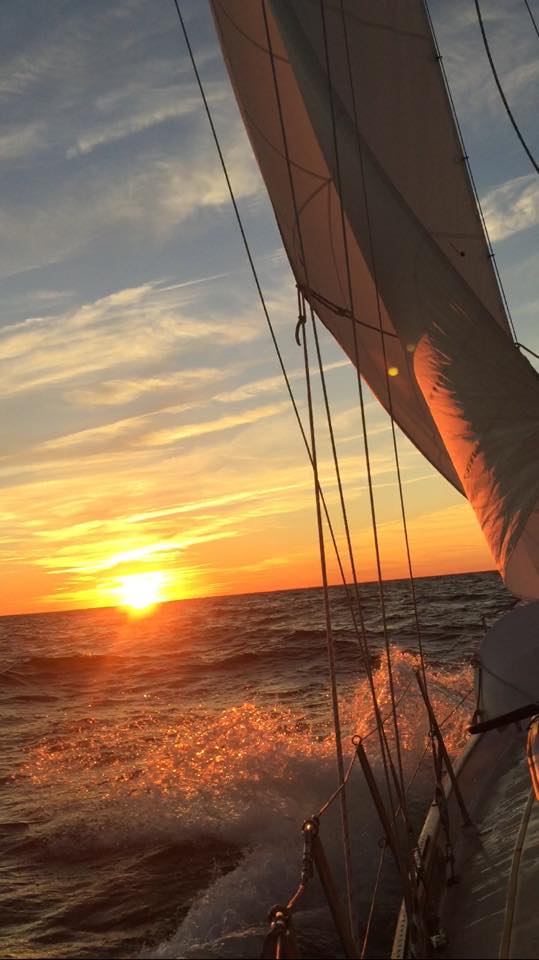
At the risk of sounding cliche, I think we can say that it has been worth the effort. The wonderful places we've seen and the fascinating people we've met have changed us in no small way. We aren't the same Scott and Noi who hoisted the mainsail with trepidation and let the wind and current carry us to the mouth of the Magothy River on Oct. 20, 2015.


Although we plan to turn north again for a probable springtime return to the Chesapeake -- and a doubtless less-than-seamless reintegration into society -- we are looking forward to all the new things we will experience on our homeward-bound meanderings.


I write as we sway gently to anchor in Prickly Bay on Grenada's south coast. 

Our log book and journals tell in short-hand the story of our journey so far: We have visited ten separate countries, plus Puerto Rico and the U.S. Virgin Islands. 

We have been escorted by dolphins and sailed nervously close to humpback whales. We've watched sharks, rays and sea turtles with a mixture of excitement and bemusement. 


We snorkeled the exquisite waters of the Exumas and felt the pure white sand of a deserted island squish between our toes. We made friends with countless locals and countless more cruisers from all corners of the planet. We caught tuna and mahi mahi, barracuda and a sailfish worthy of Ernest Hemingway. 


Dodged waterspouts. Crossed the Gulf Stream. Had engine trouble ... and then more engine trouble. Yelled at each other. Kissed each other. Ripped sails. Almost ran over a floating refrigerator, an oil barrel and a buoy. Sailed past an active undersea volcano. Went swimming under waterfalls. Swam with pigs. Got seasick. Got robbed. Went to the hospital. Won a poker tournament. Witnessed enough spectacular sunsets to last a lifetime.


In short, we are accomplishing what we set out to do. To do our own thing in our own time and by our own hand. We could have been more cautious, more concerned about money, possessions, careers and retirement. Every fiber of society tugs in the opposite direction from the one we have taken. We will no doubt be made to pay dearly for our transgression against "normalcy." But the risk of doing something unconventional seems so small compared to the risk of regret over never breaking the rules. 

We took the road less traveled ... and that has made all the difference. 


Tuesday, October 4, 2016

Matthew On A Rampage

Wind speed probabilities for Matthew. National Hurricane Center graphic.

Matthew has passed us. We knew him as a toddler with a mild tantrum. By now, however, he's turned into a ranging teenager. Unfortunately, he is going to make lots of trouble for our friends in Dominican Republic, Florida, and especially the Bahamas.

One couple from Brazil that we met at Magothy Marina a few years ago got a very late start from Florida and are in Georgetown, Bahamas, as I write. They have taken shelter at Emerald Bay Marina, but we are worried for their safely. Matthew will likely remain a Category 4 storm when it reaches them starting this evening. The force of such a storm is almost apocalyptic and the storm surge could be 10 to 15 feet in the Exumas.

When we sailed through the Bahamas in the spring, we stopped briefly at Rum Cay, an island that had been torn apart the previous year by Joaquin, a Category 3 when it hit. Matthew could prove even more destructive across a larger expanse of the Bahamas, which are barely above sea level.

And of course our hearts go out to the people of Haiti.

Another friend is in Biscayne Bay, just south of Miami. Matthew's track looked earlier like it might skirt Florida and present it with its back side -- a better outcome than the other side, due to the vagaries of cyclonic winds. Now it looks like it might be nudging west closer to the Florida coast. Not good.

For us, things are back to normal. We dodged a bullet, preparing for the worst and hoping for the best. Matthew was just getting started when it moved over us. We saw no more than 35 knots of wind -- and that in gusts. By comparison, the storm is now packing 100-knot sustained winds, with gusts as high as 130 knots. There is simply no comparison.


Wednesday, September 21, 2016

Boat Chores

Just a quick update here to say that life goes on pretty much as normal.

We are having fun in Grenada and getting some work done on the boat.

The latest chore is repainting the cabin top and deck. The non-skid was wearing through on the cabin top, which is potentially a safety issue. So, that needed to be repainted for sure, but the white trim was also looking shabby. No sense in doing one without the other.


We are also wanting to do the brightwork (i.e., varnish) -- a monumental undertaking on a Tayana 37, for sure. But we've seen a few boats here with their brightwork newly done and it is mesmerizingly beautiful. I decided on both the painting and the varnishing to do it "by the book" this time, so I have spent a few hours reading up and watching YouTube videos to get ideas on the best approach.

Doug, where are you?!

Tuesday, August 30, 2016

Grenada: How The U.S. Invasion Hit The Reset Button


If you've been following our adventures from a distance, chances are you knew nothing about the island of Grenada, up to and including exactly where to find it on a map, when we announced our arrival here last month.

You can take a moment to google it now. No, farther south. All the way down there, sort of close to Venezuela. Yeah, that's it.

If you do know anything, it's probably this: sometime in the 1980s (1983 to be exact) the U.S. rolled over this small Caribbean island in the first such deployment of American forces since the end of the Vietnam War. In one of the Pentagon's initial efforts at melding a code-name with a public-relations ploy worthy of a sixth-grader, the venture was dubbed Operation Urgent Fury.

More than 30 years later, you'd think everything would be forgotten. But you'd be wrong.

Few, if any bitter memories of Yankee imperialism. Instead, Grenadians are more likely to stop an American on the street and thank him or her for "saving" the country. That hasn't happened to me personally, but I have spoken to more than one cruiser from the states who's experienced it. There's even freshly renewed murals that appear on some street corners with American flags, or 82nd Airborne logos, thanking the United States.

This got me thinking. I do remember the invasion, but it is close to the periphery of my political consciousness. I was only 17 at the time. So, this post is sort of a study exercise in the history -- mostly for my own edification, but perhaps for you, too:

First, the backdrop. Reagan had been elected president three years before. The U.S. Marine barracks in Beirut had just been blown up by a suicide bomber, killing 241 marines. Some critics saw the move on Grenada, coming just days after the Beirut attack, as a "wag the dog" distraction (years before that term entered the popular lexicon). The evidence doesn't support that claim. However, Reagan -- always eager to reassert the Monroe Doctrine of U.S. hegemony in the Western Hemisphere -- had been eyeing the situation in Grenada for some time. An influx of money and contractors from Cuba, and some from the Soviet Union, had alarmed him. The focus of their concern was a new international airport being built on the island's south side with help from international donors, including former sovereign Britain, but most worrying to Reagan's people, also Cuba. Ostensibly a commercial entrepot, the Reagan administration saw the 9,000-foot runway, able to accommodate large (Soviet) military transports, as a threat.

PBS writes that for Reagan, Grenada had been "something of a pet project ... since his visit to Barbados in 1982." Regional leaders had bent his ear about the socialist country, that it "could become a Communist beachhead in the Caribbean."

There is some historical evidence that Grenada's governor-general at the time, i.e., the British Commonwealth's representative on the island, had requested the U.S. intervention. Assistance had also been solicited by the Organization of Eastern Caribbean States, thus giving the Reagan administration diplomatic cover.

Grenada, the smallest sovereign country in the Caribbean, had won independence from Britain in 1974. Less than a decade later, the political situation was turmoil.

The events of October 1983 would have been hard for anyone inside or outside of Grenada to follow:

The country's prime minister, Maurice Bishop -- a socialist who had forged development deals with Cuba and the Soviet Union (thus alarming Washington) -- had toppled Grenada's first premier, Eric Gairy, in a bloodless coup four years previous. On October 13, Bishop himself was deposed and placed under house arrest by his ambitious deputy prime minister, Bernhard Coard. Within days of the putsch, mass demonstrations occurred in support of the popular Bishop. The crowds snatched him from his captors and paraded him through the streets. On the same day, military chief Gen. Hudson Austin seized the government, deposing Coard and recapturing Bishop, who was executed along with several of his close associates on the same day.

Maurice Bishop
Enter the U.S. The chaos offered an opportunity to make a few points in the Cold War containment game and to get rid of the (military trained) Cuban contractors. Gen. Austin had issued a shoot-on-sight order to enforce a dawn-to-dusk curfew on the island. One main justification for the intervention was the "rescue" of some 800 students, many from the U.S., who were attending the St. George's University School of Medicine. Otherwise, they might get shot.

Six days after Gen. Austin's counter-coup, on Oct. 25, U.S. forces, including Marines, Navy SEALs and Army special forces, landed on Grenada -- deployed at several points near St. George's Bay on the southwestern and southern side of the main island (including the cruisers' anchorage of True Blue and the resort island Calivigny), as well as on the windward side near Grenville.

Credit: Wikipedia Commons
It was supposed to be a cakewalk. While no one doubted that vastly superior U.S. numbers would score a quick victory against the tiny, poorly trained Grenadian forces and the better trained, but small contingent of Cuban contractors/soldiers, it didn't go exactly as planned for the Pentagon.

Famously, U.S. forces lacked proper military-style contour maps of the island and had to rely on the same ones handed out to tourists. As a result, they had a difficult time finding the medical students they had ostensibly been sent to rescue (many of whom, when located, had no idea that an invasion was even underway). The Army and the Navy couldn't talk to one another because their radios worked on different frequencies, which contributed to a friendly fire incident that caused U.S. Navy A-7 Corsairs to mistakenly bomb a brigade headquarters of the 82nd Airborne, wounding 17 army soldiers, three of them seriously. Navy A-7s also mistakenly bombed a mental hospital instead of the actual target, the Grenadian command post at Fort Frederick. Eighteen civilians were killed in that mishap. In that same raid on Fort Frederick, three Marine helicopters were shot down. As Military.com notes, "The Grenadian Army and its Cuban allies also offered greater resistance than the Americans expected."

The whole David and Goliath confrontation ended up taking weeks instead of days and the mop up wasn't finished until mid-December. A provisional government was installed that served a year until things had returned more or less to normal and elections could be set.

For the U.S. military, it was a hard lesson. It was also a training ground for future leaders, such as Norman Schwarzkopf and Colin Powell, who both played major non-combat roles as major generals (two-star) at the time. Schwarzkopf was the Army's liaison to Vice Admiral Joseph Metcalf III. In hindsight, Powell -- who at the time of Urgent Fury was an Army liaison officer to Secretary of Defense Casper Weinberger -- deemed the operation "a sloppy success."

Today, Grenadians seem to understand that the outcome of the U.S. invasion can be separated from Washington's rationale for it. A taxi driver, who goes by the name of Cutty, who says he personally knew Bishop and other top government leaders, said he thought the United States had "done the right thing for the wrong reasons."

The threat of communism in the Caribbean, especially given the collapse of the Soviet Union a few years later and the slow withering of Cuba that it triggere, was overblown. Serious Soviet military adventurism in the Caribbean arguably ended with the Cuban missile crisis and despite some support for civil wars in Central and South America, was never again a serious regional challenge to the U.S.

For Grenada, however, U.S. military forces helped push a reset button on the island's politics. Since 1983, there have not been any more coups. Democratic governments have come and gone, with peaceful transitions.

And that airport that caused so much concern? That would be Maurice Bishop International.


Tuesday, August 23, 2016

Eric's Visit

Our son Eric arrived at Grenada's Maurice Bishop International Airport nearly ten months after our tearful parting on the main dock at Magothy Marina, as we prepared to cast off the dock lines for the last time and set off on the ventured in these pages.

On a plane-load of heavily laden medical students from the U.S. preparing for the start of classes -- and seemingly bringing complete dorm rooms with them, Eric, toting just two carry-on bags, looked a little out of place.

To be sure, Eric always looks a little out of place. It's a hereditary trait.

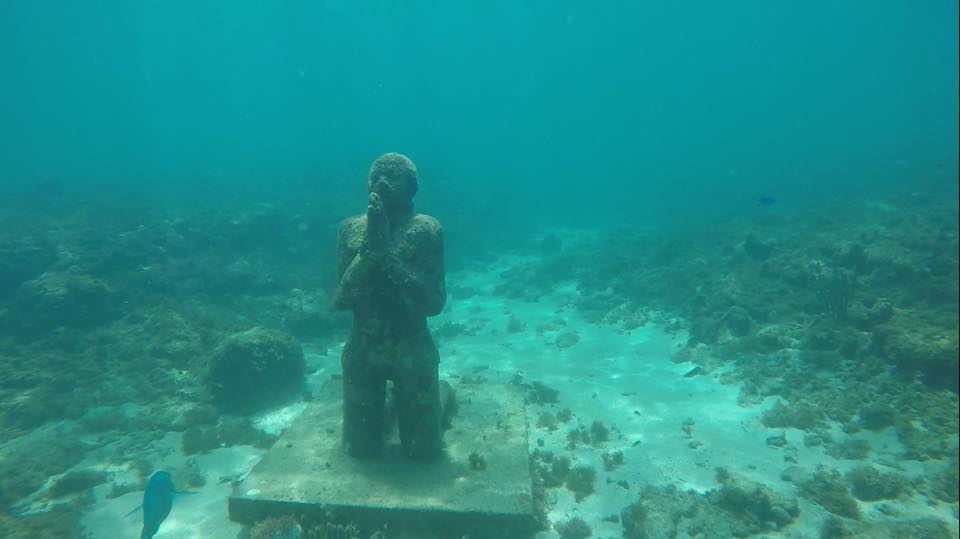
The day after he arrived, we had planned to go snorkeling, but pushed it back a day due to overcast conditions and rain that would have reduced "viz." The next day, however, we went out in a glass-bottomed boat to visit a set of sunken statues at Grand Mal Bay, just north of St. George's Harbour. The story here is that about 15 years ago an artist got permission to drop his sculptures in this small bay as a work of art -- something like an undersea Christo project, I suppose. I believe he's the same artist responsible for similar pieces in Mexico and the Bahamas.


Our next big adventure was an all-day island tour. Noi and I had been saving this trip (and the snorkeling) until Eric showed up. We were accompanied by our friends on M/V Tropical Blend, Debbie and Larry.


Water wheel the still turns the sugar-cane press at Rivers Rum Distillery.

Eric makes the leap at Annandale Falls.


Raw cocoa.

Nutmeg. The red part is mace. The outer shell is used in cosmetics.

Nutmeg drying out at the processing facility.


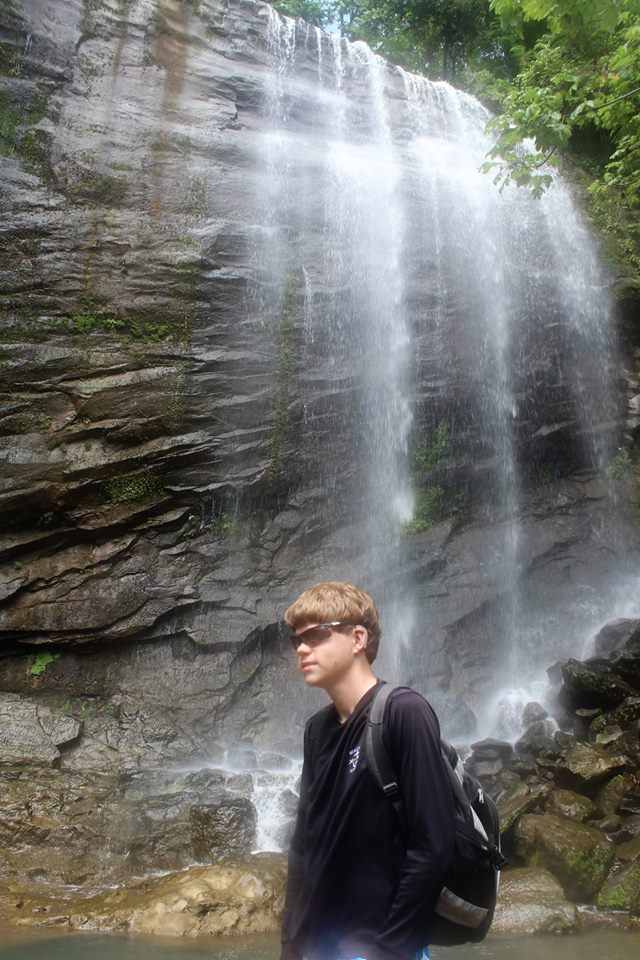
Later in the week, we also hiked up to Mt. Carmel Falls, which was even more stunning than Annandale.


And, of course, there was the unfortunate incident of a boat burglary, which you can read about here.

It was sad to see Eric leaving again on the 22nd, jetting off for his school, his jobs, his life. 

We wish he could stay!