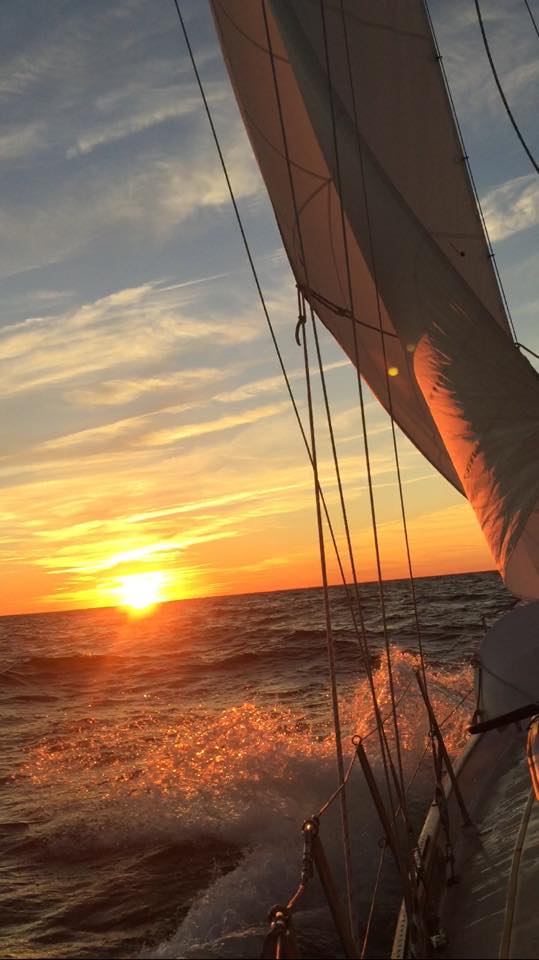
Wednesday, February 8, 2017

Waiting For Weather; Boat Projects

I look at my last post and can't believe how long it's been since I was writing here. I have been getting a lot of boat projects done, but not much writing.

We ended up spending five weeks in Antigua then hopped up the chain to St. Maarten (Dutch side) and have been here for more than two weeks getting boat projects done and relaxing. I am far behind both on this blog and on my freelance assignments -- I have three in the pipeline and should be pitching two more.

What about those boat projects? Well, here's a sample:


Brightwork. The cockpit.
Elbow in the exhaust line (not "exhaust elbow," however). The tiny hole was spurting water around the engine room.


Working on the outboard.

Making new mooring lines.

Just to prove it hasn't been all work. A close-encounter with dolphins en route from Nevis to St. Maarten.

Friday, December 23, 2016

Christmas In Antigua


Last Christmas, I was sitting in a hospital in Freeport, Bahamas, waiting to have the end of my left pinky stitched up. This year, we are hoping for a somewhat different holiday -- in Antigua, but definitely not in an Antiguan hospital!

Today, we are Med-moored (i.e., without a finger pier) in Jolly Harbour Marina, next to cruising buddies Tropical Blend and AfterMath. John and Debbie on AfterMath have just flown back to U.S. to be with family, leaving Kirby -- their Wheaton Terrier -- at a local kennel. Larry and Debbie on Tropical Blend are remaining here in Antigua, their soon-to-be home, as they are in the process of closing on a house here.

So, the four of us will celebrate, which will probably involve the beach and some lobsters!

Martinique

I should probably back up a bit, as I haven't posted since Martinique. We spent a bit of time on that particular French island enjoying our favorite anchorage and town, St. Anne. That was where we had a small adventure getting Quincy, Tropical Blend's nearly 22-year-old cat, to the veternarian. The first problem was finding a vet and then finding out if the clinic was open. Of our little group, I am the only one that knows any French -- and when I say "any" I am saying pas beaucoup. I tried to listen to a telephone recording, but between the usual garble and the French that I didn't know, I was unable to pick up much of anything. Larry and I set off in the dinghy from the anchorage toward town, where a very nice gentlemen who runs "Bou Bou Snackette" had been very helpful when we first checkedin, despite his limited English. En route, I spotted a Canadian-flagged sailboat with a Montreal hailing port and it occurred to me that she probably had bilingual crew. We motored up, introduced ourselves in English and, sure enough, the couple aboard was able to help us. We still had time to get Quincy -- who was suffering from a tumor-like growth -- into the vet's office. All is well and Quincy is still alive and kicking on an (almost) daily diet of KFC.

Debbie and Quincy en route to the vet in Martinique.
Owners of the Bou Bou Snackette in St. Anne. As you can see, they are Breaking Bad fans!
Scott doing brightwork in Grand Anse D'Arlet, Mart.

Sea turtle in Grand Anse D'Arlet.
From St. Anne, we decided to move up to Grand Anse d'Arlet for Thanksgiving. That's where we, at anchor, we experienced the worst of our sailing experience. Ironically, it all happened on the very same day that I wrote the previous post about anchoring in which I joked about tempting the gods! The wind suddenly went west, strongly (30-40 knots), which means we swung around 180 degrees on our anchors and were backed up to a lee shore. For landlubbers, this means that our anchor (and everyone else's) was "set" in one direction, i.e., against the prevailing easterly winds. So, the fluke, or hook of the anchor was dug into the sandy bottom so that it is secure from that direction. When the wind goes the opposite way however, things get interesting. Pulling in the opposite direction of the set is a very good way to pull the anchor out. Worse, spun around in that direction, if the anchor loses its hold on the bottom, we go on the beach instead of (safely) out to sea.

It was much drama for a few hours, but our anchor held and no one dragged down on us. AfterMath did have some trouble and called on the radio for help. Larry, who already had Tropical Blend's dinghy in the water, shuttled over to Symbiosis and picked me (Scott) up, so we could go help. At this point, a several foot swell was coming into the anchorage, and Larry's maneuvering to get himself, and then me, aboard the dinghy was impressive. By the time we got over to AfterMath, the problem (entanglement with another boat) had been resolved. Although AfterMath did sustain some damage, it wasn't, luckily, more than cosmetic.

A few days after the anchorage excitement, we went up the west coast to St. Pierre, a passage that brought us around Diamond Rock in a 30-knot squall. It wasn't the most pleasant sail, especially given the rain.

St. Pierre is a small but interesting town that we had visited on our way south. And, a very tricky anchorage. In front of the town, there is only a narrow near-shore shelf where the water is shallow enough to set the hook. On the way south last summer, we opted to anchor at a beach adjacent to the town, where there is more room. But this time we had a strong swell coming in from the west that would have set us onto the beach. After Symbiosis reconned the spot, we made an executive decision not to use it.

The main goal in stopping at St. Pierre was to shave a bit off our next passage to Dominica and to check out (clear) immigration and customs. In the true spirit of the French islands, however, the customs office was closed, despite posted hours that suggested that should not be the case. Stay another day to clear customs/immigration or just leave for Dominica and hope the officials there are understanding? The latter option was the one we chose, and it worked out fine. We got the distinct impression that the customs officers in Dominica had heard this story of their errant French colleagues before.

Dominica


Prince Rupert Bay, Portsmouth, Dominica.
We arrived back at Prince Rupert Bay, Portsmouth, for another stay of several days. This was one of our favorite spots on the way south. Unlike some other places, the boat boys are well-organized in this particular harbour. "Daniel" helped organize a tour of the south end of the island for the four of us on Symbiosis and Tropical Blend. We had seen the north end on the way down, so we wanted to see the rest of the island. Another great day at the sulfur hot springs near Soufriere.

Guadeloupe

We finally got to see Les Saintes, a set of islands just south of Guadeloupe that we had skipped on the way down. However, Debbie and Larry, had stopped there for a few days at that time and had (along with everyone else we spoke to) great reviews on the place. It is indeed a lovely little spot and is now on our short list of favorites. The town, Terre de Haut, is nearly the perfect French Caribbean town. Not too big, not too small. Lots of little shops to browse. And the rest of the main island is stunning.

Lastly, a word about the sail from Guadeloupe to Antigua. Symbiosis had a bone in her teeth and kicked butt in 20 knots of wind and 6-foot beam seas. The windvane steered all the way with just a bit of tweaking. With two reefs in the main, the staysail flying and a one-third rolled Yankee, we blistered along to make a 6.4-knot average, our best "non-surfing" performance! Video below!


Monday, November 28, 2016

The Science And Religion Of Anchoring

Noi scanning for a good spot at Deshais, Guadeloupe
"We must respect the other fellow's religion, but only in the sense and to the extent that we respect his theory that his wife is beautiful and his children smart." -- H.L. Menchen.


You've heard it all before: new-fangled super-anchor, all-chain rode, plenty of scope, snubber. Check your set. Yep. That's anchoring in a nutshell. At least the science part of it.

Putting theory into practise, however, isn't always a fully quantifiable exercise. I will try not to sound smug or arrogant, lest we tempt the gods. We are not experts! However, after dropping the hook perhaps one-hundred times in the past year or so, we have not dragged once, either in fair weather or foul. That counts for something, I suppose. Pride before the fall?

First, if you're planning long-term cruising, take a deep breath. Now, double the line item in your budget for anchor and ground tackle. Put a pencil line through the satellite phone entry if necessary. You will miss a good anchoring kit that works 100 percent of the time a whole lot more than that sat phone that is only 30 percent reliable. Trust me on this one.

Anchors fall into the purgatory between science and religion. We love our primary anchor -- a Spade. Why do we love it? Because it has never let us down. Does that mean that it never will? We have no way of knowing that. But we have faith.

We did our research before buying the Spade. The numbers looked good in the (few) unbiased reports we could find. But, we could just as easily have gone with a Rocna, and most certainly would have if only it had fit our bow roller. The two hooks are roughly equal in performance. The only real difference is that the Spade is more expensive.

When we bought Symbiosis, she came with an oversized CQR and a large Bruce. When we purchased the Spade, we got rid of the CQR, but kept the Bruce. The reasoning was that the CQR and Spade were similar "plow-type" anchors, so they were basically duplicates (although we were quite sure the Spade was far superior). The Bruce is perhaps better than the Spade in a few types of bottoms, so it seemed the better choice to keep. Having said that, the Bruce has never come off the bow roller. We haven't found -- at least in the Chesapeake, down the ICW, the Bahamas and the Eastern Caribbean -- any reason not to use our Spade every time. And it's held nicely -- every time.

I passed up a good deal on a used Fortress I found at Bacon in Annapolis just before we cast off. I have been kicking myself ever since. It would be, in my mind, the ideal complement to the Spade and Bruce. It is an excellent anchor for kedging or for holding against strong wind in a single direction (its main drawback being that it does not reset as well as the others). In addition, it is very lightweight for its holding power, which makes it easy to handle, and it disassembles for easy storage.

A word about weight: I agree with the conventional wisdom to go big. Our Spade is a size heavier than recommended. Why not "supersize" me when it comes to anchors and go two or three sizes bigger? It sounds great in principle, but there's a limiting factor. We do not own an electric windlass and neither do you. For us, that's a literal statement (ours is an old manual Simpson-Lawrence Sea Tiger 555), for you, it might be theoretical. You might have a kick-ass electric windlass, but unless you can get the anchor up with two (or four) hands, the anchor is too big. Electric windlasses are one of those items that (along with refrigerators, water-makers and autopilots) keep marine repair folks in business throughout the Caribbean. Our buddy boat, Tropical Blend, recently experienced a jammed gypsy that resulted in a burned out motor. It took four of us to retrieve their 110-pound Bruce. The advantages of buddy boating!

Stainless vs. galvanized? I honestly cannot see any advantage to stainless except aesthetics. They do look nice and shiny. But at nearly twice the price for the stainless-steel versions, I can use the mirror in the head to brush my teeth. 

The next link in the chain, so to speak, is the connection between the anchor and rode. A high-quality swivel, such as made by Italy-based Kong, is a good investment. When the anchor comes up, it is almost invariably twisted the wrong way. The swivel will get it turned around easily.

And the rode. We met a couple in Florida who had been cruising for quite some time in the Bahamas on their home-built motorsailor. They claimed to be anchoring gurus and even had a self-published book on the subject. This couple were strong advocates of chain and nylon line instead of all-chain. They insisted that the elasticity of the nylon rode made for more secure foul-weather anchoring and that the extra weight of all-chain wasn't all that valuable. They have more experience than I do, but by contrast, nearly everyone who is a serious cruiser in the Eastern Caribbean uses all-chain rode. For us, it is the combination of the Spade and the chain rode that we believe (because, remember, it is religion we're talking about here) has kept us safe up to now.

To complete the kit, there's the snubber. The winter before we set off on our big adventure, I did a bit of research on snubbers and bridles. I can't say the research was exhaustive, but for some reason I concluded that I wanted a Y bridle rather than a single-line snubber (which is what most monohull sailboats use). I looked at the one Mantus sold and decided that it would be easier (and cheaper!) just to copy it. Using 3/4" three-strand nylon, a stainless eye thimble, a chain hook and some chaffing gear, I set about recreating that bridle. It doesn't look nearly as good as the fancy Mantus bridle in the magazine ad, but it has proven excellent gear. It is, however, a bit of a struggle getting it around all the bowsprit stays on Symbiosis. One major advantage, in my mind, is that with the bridle (as opposed to the one-line snubber), you artificially increase scope by hooking the chain at or near the waterline, which reduces the angle of pull to the anchor. Those few feet from the bow roller to the waterline can make a lot of difference.
The home-brew bridle/snubber.


Middle: Our Spade well dug-in in Bahamas. Bottom: A Rocna(?) in Martinique.
How to pick an anchoring spot? We tend to only go for "approved" anchorages (i.e., those places marked as anchorages on the chart). On occasion we go off the beaten path, but seldom. We are conservative when it comes to anchoring and other sailing things and centrist or liberal on pretty much everything else. In a crowded anchorage, it's obviously important to have plenty of room to swing and to stay away from your neighbors. All well and good, but sometimes you have to make compromises. More than a few times we've found ourselves a bit too close for comfort with our neighbors -- either because we anchored closer than we should have or our nice and open spot looked good to everyone else who followed us. It is amazing how quickly the perfect anchoring spot can become downtown central.

On the rare occasions when we really feel uncomfortable with an usurper, we move. For those times we feel uneasy as the potentially offending party, we dinghy over and ask the neighbors how they feel. Almost invariably, this defuses the situation. Granted that it's human nature to avoid conflict and the smiles we typically get might be masking gritting teeth. But, if nothing else, it lets them know that we are keeping a close eye on the situation and are prepared to move if necessary. The truth is that we never hit anyone swinging at anchor and no one ever hit us. Sure, strictly speaking, there's some math I could pull out of my sail bag to explain scope and swinging room. If that's your thing, have at it. But, for us it's more a feeling. Not very scientific.

When we anchor, Noi is on the foredeck and I am at the helm. While we are still on approach to the anchorage, Noi is using the binoculars to scout out potential spots. A short discussion (or sometimes argument) ensues and we head for the spot we've picked (or the one I've picked). Thick mud is ideal, but we haven't seen that since the ICW. In the Bahamas and Caribbean, we are looking for lily-white sand on the bottom. And, if the sun angle is right and the water is relatively calm, we might be able to spot it visually. Looking at the chart plotter, I am careful to avoid areas marked "sand and coral." Sometimes that means "sand over coral," which is not good. Additionally, sometimes what looks like sand turns out to be broken shell or coral -- also unsuitable. But it's difficult to know that until you've actually dropped the hook. 

So, what about scope? Our standard is about 7-to-1, regardless of the conditions. Too many times we have seen squalls roll in unexpectedly, with wind quickly ramping up from nil to 30 knots or more. You don't want to be fooling with the anchor then. Here's an example of how I figure scope: if the depth finder says 15 feet, I add five feet for the distance from the waterline to the roller on the bowsprit. 20 x 7 = 140, so I round up to 150 (which, in any case, is an increment marked on the chain rode). If I am feeling a bit nervous about the weather, I spill out a bit more for good measure.

If the water is clear enough (which isn't always the case), we do like snorkeling on the anchor to see how well it is set. If you own a "look bucket" that works too. On at least one occasion, Noi went out to check things and reported that the Spade was over on its side and only partially dug in. We decided to yank it up and do it over.

After all that, it was just a matter of getting comfortable with the routine and what to expect from it. 

Sure, I still get a little nervous when 40 knots comes through our anchorage, but I don't panic. I am pretty confident that we are doing the right thing. The science (and our experience) is what gives me confidence, though. Others might prefer the power of prayer.

Friday, November 25, 2016

Thanksgiving In Martinique

After many years of living abroad on and off, I know how difficult it can be to keep going with traditions associated with the home country. Thanksgiving has always been my favorite holiday -- a family get-together without the gift-giving associated with Christmas. Much more relaxed.

One memorable Thanksgiving (in the mid-90s) was spent with Swedish journalists Ulf and Maud Linholm in India, who of course had themselves never had an "American" Thanksgiving. Not all the ingredients were available, of course, but we managed a pretty decent feast nonetheless.

The dinner we had yesterday in Martinique with buddy-boating friends John and Debbie aboard AfterMath and Larry and Debbie aboard Tropical Blend was equally memorable. AfterMath Debbie took the lead on the project and we managed to have turkey, mashed potatoes and gravy, stuffing, and green beans. What a pleasant afternoon!


Monday, November 14, 2016

Moving On. But Where?

Tobago Cays, St. Vincent and the Grenadines
We are in Rodney Bay Marina in St. Lucia getting a few boat projects done while we try, with limited success, to shut out the rest of the world.

The big question is where do we go from here? When we left the U.S. a year ago October, we only committed to the Caribbean, although we (or at least I) definitely had a circumnavigation in the back of our minds. Of course, even to suggest such a possibility to others was a mistake. No matter the caveats, friends and family think you're going to "sail around the world."

I still love that idea, however. Alas, our budget does not. It's not really possible to start off heading west and then decide along the way. The Panama Canal is an expensive and involved proposition. Once through it, the options narrow. The only "logical" move is to do the Pacific crossing -- the Marquesas, Tahiti, etc., to Asia. Not out of the question, but then the boat is stuck half-way around the world and the only "logical" way to get it back home is to keep going, through the Indian Ocean and across the Atlantic. The whole project is a years-long proposition and nothing to take lightly. Are we up to it financially or psychologically? Financially, we might just make it, though I am doubtful even of that. Otherwise, I think I am ready for the challenge. Noi is much less enthusiastic.

Short of that, what? Returning to the U.S., as of Nov. 8, has suddenly become a lot less appealing. Besides, we have no real job prospects there. A few weeks ago we were thinking of heading west to Jamaica, Caymans and Isla Mujeres in Mexico before heading back, but now we might want to take longer. An Atlantic crossing to Europe has some appeal, but the cost of hanging out for any length of time in the continent (weather would necessitate it) would probably be prohibitive, too.

In the midst of all this, I have suddenly developed a chronic back issue that I can't figure out. It feels muscular (lower left) and comes and goes in intensity of pain. It's been going on for about two weeks now and is really bothering me. I have been taking Ibuprofin and gin. Both seem to help, but quite obviously neither is a long-term solution -- it's probably not a good idea to take that much Ibuprofin and eventually the gin will run out. I could go to a doctor here in St. Lucia, but somehow I feel like that might be fruitless, too.

So, that's sort of where we are right now. Just thinking, but trying not to think too much.

Wednesday, October 19, 2016

The Year Of Living Sailorly

"You will go on, and when you have prevailed
You can say: at this point many a one has failed." -- T.S. Eliot, Portrait of a Lady

It was a year ago tomorrow that we and Symbiosis set sail from a cozy slip on the Chesapeake, bound for the adventure of our lifetimes. We knew there would be many trials and triumphs along the way.

At the risk of sounding cliche, I think we can say that it has been worth the effort. The wonderful places we've seen and the fascinating people we've met have changed us in no small way. We aren't the same Scott and Noi who hoisted the mainsail with trepidation and let the wind and current carry us to the mouth of the Magothy River on Oct. 20, 2015.


Although we plan to turn north again for a probable springtime return to the Chesapeake -- and a doubtless less-than-seamless reintegration into society -- we are looking forward to all the new things we will experience on our homeward-bound meanderings.


I write as we sway gently to anchor in Prickly Bay on Grenada's south coast. 

Our log book and journals tell in short-hand the story of our journey so far: We have visited ten separate countries, plus Puerto Rico and the U.S. Virgin Islands. 

We have been escorted by dolphins and sailed nervously close to humpback whales. We've watched sharks, rays and sea turtles with a mixture of excitement and bemusement. 


We snorkeled the exquisite waters of the Exumas and felt the pure white sand of a deserted island squish between our toes. We made friends with countless locals and countless more cruisers from all corners of the planet. We caught tuna and mahi mahi, barracuda and a sailfish worthy of Ernest Hemingway. 


Dodged waterspouts. Crossed the Gulf Stream. Had engine trouble ... and then more engine trouble. Yelled at each other. Kissed each other. Ripped sails. Almost ran over a floating refrigerator, an oil barrel and a buoy. Sailed past an active undersea volcano. Went swimming under waterfalls. Swam with pigs. Got seasick. Got robbed. Went to the hospital. Won a poker tournament. Witnessed enough spectacular sunsets to last a lifetime.


In short, we are accomplishing what we set out to do. To do our own thing in our own time and by our own hand. We could have been more cautious, more concerned about money, possessions, careers and retirement. Every fiber of society tugs in the opposite direction from the one we have taken. We will no doubt be made to pay dearly for our transgression against "normalcy." But the risk of doing something unconventional seems so small compared to the risk of regret over never breaking the rules. 

We took the road less traveled ... and that has made all the difference. 


Tuesday, October 4, 2016

Matthew On A Rampage

Wind speed probabilities for Matthew. National Hurricane Center graphic.

Matthew has passed us. We knew him as a toddler with a mild tantrum. By now, however, he's turned into a ranging teenager. Unfortunately, he is going to make lots of trouble for our friends in Dominican Republic, Florida, and especially the Bahamas.

One couple from Brazil that we met at Magothy Marina a few years ago got a very late start from Florida and are in Georgetown, Bahamas, as I write. They have taken shelter at Emerald Bay Marina, but we are worried for their safely. Matthew will likely remain a Category 4 storm when it reaches them starting this evening. The force of such a storm is almost apocalyptic and the storm surge could be 10 to 15 feet in the Exumas.

When we sailed through the Bahamas in the spring, we stopped briefly at Rum Cay, an island that had been torn apart the previous year by Joaquin, a Category 3 when it hit. Matthew could prove even more destructive across a larger expanse of the Bahamas, which are barely above sea level.

And of course our hearts go out to the people of Haiti.

Another friend is in Biscayne Bay, just south of Miami. Matthew's track looked earlier like it might skirt Florida and present it with its back side -- a better outcome than the other side, due to the vagaries of cyclonic winds. Now it looks like it might be nudging west closer to the Florida coast. Not good.

For us, things are back to normal. We dodged a bullet, preparing for the worst and hoping for the best. Matthew was just getting started when it moved over us. We saw no more than 35 knots of wind -- and that in gusts. By comparison, the storm is now packing 100-knot sustained winds, with gusts as high as 130 knots. There is simply no comparison.